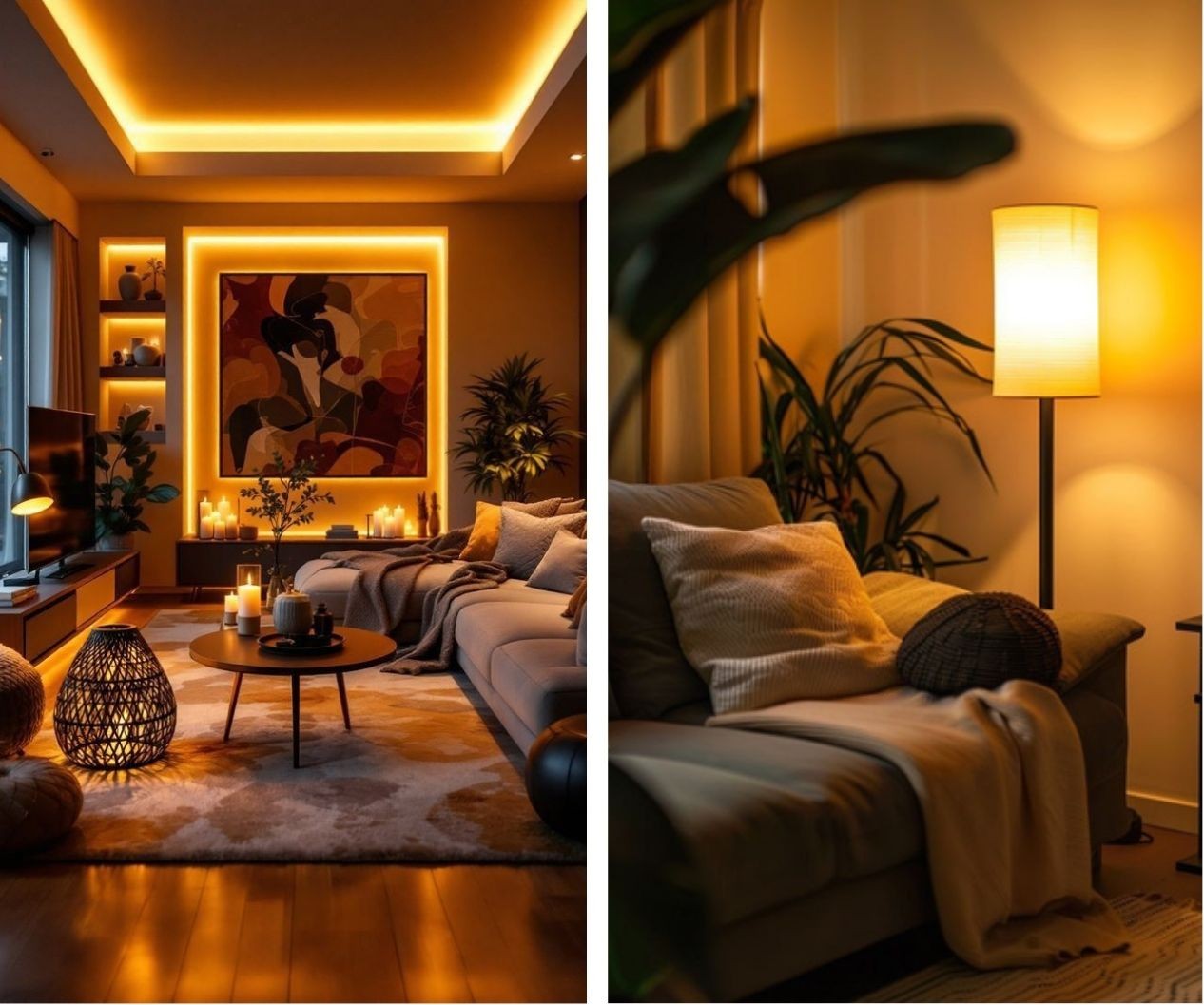
Speak It in Your Home
By Emmanuella Abraham
Imagine light as an invisible artist in your house: it doesn’t just illuminate walls, it paints your emotions. Proper lighting can literally change how we feel and perceive a room. As Unibox notes, “lighting has a profound effect on how we feel, think, and behave”. In other words, the glow, shade, and color of light become a kind of vocabulary, a way your rooms can express comfort, luxury or tranquility. This guide explores how to read and write that language of light in your interiors, with facts, expert insights, and practical tips to transform any space.
Seeing Light as a Storyteller
An eye-catching pendant lamp becomes more than decoration: as designer Christophe Mathieu observes, “Light is also a language. The lamp becomes an object that speaks and sparks a series of sensations inside you”. In practice, this means your lighting fixtures tell a story. A single glowing lamp can feel intimate or dramatic; a cluster of spotlights can create focus or contrast. Even in museums, lighting designers say “Light is a language, through which visitors can talk to the history”. In your home, this translates to intentionally choosing and placing lights so that they convey mood. For example, a soft amber bulb in the bedroom can whisper “relax,” while a bright, directional beam over a kitchen counter can say “pay attention here.” The architecture itself can become a dialogue partner: smart lighting can follow the room’s lines and shapes to highlight features or create patterns of shadow, as if the walls themselves are speaking through illumination.
The Mood of Light and Atmosphere
Light shapes ambiance in profound ways. Bright daylight floods a room with energy and openness, while warm lamplight can wrap a space in coziness. In fact, designers find that mixing lights of different scales and strengths is the secret to atmosphere. Interior designer Nicola Harding explains: “That variety, both in scale and in quality of light, creates atmosphere. Without it, even the best-designed space can feel flat.” She calls this mix “a blend of types of light [that] gifts a beguiling atmosphere.”
To see why, consider how lighting affects our brains: as Unibox reports, “lighting impacts our brains in fundamental ways. It affects how we perceive spaces [and] influences our mood”. A stark office light might boost alertness temporarily, but in a bedroom or lounge it feels harsh or unsettling. Conversely, warm, low-intensity lights naturally promote relaxation, even sleep, by mimicking the softer glow of sunset. (Studies show warm lighting “promotes relaxation and plays an important role in our circadian rhythms to help us fall asleep”.)
In practical terms, a well-lit living room often uses a combination of overhead lights, table and floor lamps, and accent lights: each layer contributes to a rich, dynamic scene. This is why homes that feel inviting usually “have enough lamps” of different kinds, creating pools of light and shadow that make a room feel alive.
Layering Light: Key Types and Techniques
Good lighting design uses different types of lighting, like words in a sentence. The basic categories include:
- Ambient (general) lighting: A background glow that gently fills the room. It’s often indirect or reflected (such as from wall sconces or a central ceiling light), creating an overall “warm-tone, tranquil and cozy” environment.
- Task lighting: Bright, focused light for activities like reading, cooking or working. Think under-cabinet LEDs in a kitchen or a desk lamp by the work table.
- Accent lighting: Narrow beams that highlight art, plants or architectural features – like spotlights on a painting or LED strips under shelves. These draw your eye and add drama.
- Decorative lighting: Pieces that are as much art as function, such as a sculptural chandelier or designer floor lamp. These “speak” visually even when off, but when lit they add character and flair.
Combining these layers transforms a space. For instance, a living room might have warm ambient light from a dimmable ceiling fixture, supplemental task light by a reading chair, and accent light pointing at a favorite painting. Each layer can be adjusted (with dimmers or smart bulbs) to create different moods.
Remember Albert Hadley’s insight: “Design is defined by light and shade”. In practice, this means paying attention to where shadows fall and ensuring you have uplights and downlights at varying heights, so your eye always moves around the room. A key rule from designers is to “have a blend” of lamps in various sizes and styles, some diffused by fabric shades, some sharply focused, because that variety is what creates a layered, comfortable ambiance.
Practical Tips for Writing with Light
Ready to let light speak in your space? Here are some guidelines and ideas:
- Maximize natural light: Open curtains and blinds during the day. Sunlight is free and energizing; it “is mentally stimulating” and lifts mood. When sunlight is too harsh or causes glare, use sheers, louvered blinds or reflective surfaces to diffuse it gracefully (designers often place mirrors to amplify daylight). Even letting a skylight or high window flood a hall can feel magical, as architecture and light work together.
- Choose warmth for comfort: For living areas and bedrooms, favor warm-white bulbs (around 2700–3000K). Haley’s design guide points out that ambient lighting is usually warm-toned, because it creates tranquility. Warm LEDs or vintage filament bulbs conjure that cozy firelight glow. Reserve cool-white lights for task zones like offices or kitchens, where crisp clarity is needed.
- Layer multiple lamps: Instead of relying on a single ceiling fixture, scatter several light sources. Use table and floor lamps at different heights to break monotony. For example, a floor lamp in a corner plus a pair of table lamps flanking a sofa will produce a richer atmosphere than a lone overhead light. As Nicola Harding advises, ask “does your room have enough lamps?”– the answer is usually yes.
- Employ dimmers and smart controls: Install dimmer switches or smart bulbs that can change intensity and color. This flexibility lets you “get the lighting right” for each moment. Bright, cold light can stimulate focus during the day, while a gentle amber dusk mode can ease the house into evening. Even simple timers can mimic natural cycles – e.g., slightly increasing brightness in the morning and lowering it after dinner, in line with our circadian rhythms.
- Use accentuation: Direct light onto things you want to showcase. A picture light or a spotlight over a sculpture “translates into greater comfort,” said Mathieu, when we use it to frame objects. Don’t forget under-cabinet lighting in the kitchen or toe-kick lights on shelving, these not only help functionally, but also add visual depth.
- Experiment with color and shape: Modern smart bulbs can glow in colors beyond white. A pale blue or pink twilight effect can evoke a serene or romantic vibe. Meanwhile, think of light fixtures themselves as décor: a chandelier or pendant is a “letter in your light alphabet”
– as Artemide’s Alphabet of Light concept puts it, shaping the form of light in the room. Bold fixtures cast interesting shadows and can become focal points even when switched off.
Experts Insights and Inspiration
Many designers emphasize learning from architecture and global traditions. The great designer Ettore Sottsass observed that some cultures treat “every project [as] a construction of light, before walls, floors, and ceilings,” ultimately concluding “Light is a language” in itself. In other words, look to Japanese or traditional designs: paper lanterns, shōji screens, and layered gardens often rely on subtle light-play to define space. Emulate this by highlighting textures (like a brick wall or woven rug) with grazing light.
Finally, remember that expert opinion is unanimous: good lighting is non-negotiable. LuxDeco reminds us that proper lighting “is enormously important” in defining design. So when planning or renovating, treat light fixtures and bulbs with as much care as paint colors or furniture. Think of each lamp as a “word” in your design, choose them so they compose the mood and style you want. With careful layering and creative choices, you’ll soon find your home speaks fluently through its light, telling a unique story of warmth and welcome.