Spotlighting Remarkable Women and Girls

CNN Exposed It. The Internet Reacted. But We’re Still Missing the Point

By Antoine Pepper

When CNN published its investigation into online communities where men were sharing and enabling sexual violence against women, it did not take long for the story to spread.

The report uncovered networks operating across encrypted platforms, where users exchanged tactics, substances, and in some cases, footage tied to abuse. It pointed to a system that was not isolated, but organised enough to raise serious questions about how these spaces are allowed to exist at all.

It was disturbing. It was real. And it demanded attention.

The reaction was immediate.

Not quiet concern. Not slow reflection.

Immediate.

Across social media, people responded in real time. Screenshots circulated. Threads formed. Opinions hardened within hours. For many, the story confirmed something they had always suspected. For others, it raised questions about how far the claims actually went.

But somewhere between the reporting and the reaction, something else began to unfold.

The conversation itself became part of the story.

On Reddit, in one of the most widely shared discussion threads responding to the investigation, a user wrote:

@throwaway_speakup (Reddit):

“This broke something in me. I am so tired of being angry but what other option is there?”

That response was not about numbers or evidence. It was about recognition. For many women, the report did not feel like new information. It felt like confirmation of a pattern they already navigate quietly.

Another user, in the same discussion space, shifted the focus away from emotion and towards structure:

@cyberwatcher (Reddit):

“Even if people argue about the scale, the real issue is that these spaces exist and grow before anyone steps in.”

This is where the conversation begins to sharpen. Because beyond the shock of the investigation is a more uncomfortable truth. These digital spaces are not anomalies. They are often the result of systems that prioritise engagement over accountability.

Still, not everyone accepted the narrative without question.

On X, users began pushing back against how the story was being interpreted and shared:

@DataCheckNow (X):

“People are mixing up site traffic with actual participation. We need to be careful or we lose credibility.”

That caution reflects another layer of the conversation. In the rush to react, details can blur. Metrics can be misunderstood. And when that happens, even legitimate concerns risk being dismissed as exaggeration.

On Instagram, however, the tone is different. Less analytical. More direct.

@nina.writes (Instagram):

“You can debate numbers all day but women are still the ones adjusting their lives to stay safe. That is the reality.”

This is where the tension becomes clear. One side is asking for precision. The other is pointing to lived experience that does not depend on perfect data to be valid.

Both are speaking to the same issue from different positions.

Then there are those who see a larger pattern in how these stories unfold online:

@realist_mind (X):

“This is what the internet does. Something real happens, then it gets amplified, distorted, and turned into something harder to trust.”

That observation may be the most important one.

Because what the CNN investigation exposed is not just a problem of harmful online communities. It also exposed how quickly serious reporting can be absorbed into the internet’s reaction cycle.

A cycle where:

Information spreads faster than context.

Emotion travels faster than verification.

And outrage often becomes the headline.

The result is a conversation that feels loud, urgent, and fragmented all at once.

But beneath that noise, there are still clear facts.

There are documented cases of non-consensual content being shared online. There are communities that operate in ways that enable harm. There are gaps in platform moderation and regulation that allow these spaces to persist longer than they should.

Those realities do not depend on inflated numbers to matter.

At the same time, how we talk about these issues matters just as much as the issues themselves. When claims are overstated or poorly framed, it becomes easier for people to dismiss the entire conversation. The focus shifts from accountability to argument.

And that shift benefits no one.

Which is why the response going forward has to be more deliberate.

Stronger restrictions and enforcement must be placed on platforms that allow this kind of content to exist and circulate. Not as a reaction to outrage, but as a consistent standard of accountability. Digital spaces cannot continue to grow faster than the rules that govern them.

At the same time, the information that reaches the public must remain accurate and responsibly framed. Because when facts are stretched or misrepresented, the conversation quickly turns into something else. It creates fear that is not always grounded, and tension that is often misdirected.

And in moments like this, that tension can easily shift into a blanket suspicion, where people begin to see every man as a potential threat rather than focusing on the specific systems and behaviours that need to be addressed.

Accountability matters. Accuracy matters just as much.

If either is missing, the conversation loses its power.

CNN started the conversation.

But what happens next depends on whether we choose clarity over noise, and solutions over reaction.
Share:

Trending

Raising Women Magazine Issue 56 – November 2026

The Courage to Question
We live in a world where reputation often arrives before character, popularity masquerades as goodness, and questioning authority can make you the problem. Apparently, being respected is sometimes mistaken for being beyond reproach.
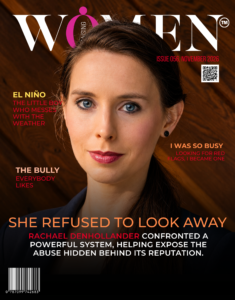
Our cover woman, Rachael Denhollander, reminds us why that distinction matters. Her courage in confronting institutional abuse challenges us to reconsider what safety, justice and accountability truly mean.

Elsewhere, we explore the judgement surrounding childbirth, the invisible labour behind successful careers, the beauty industry’s obsession with perfection, and why women can cook the same meal as men yet receive considerably less applause.

From fashion and culture to relationships and motherhood, Issue 56 invites us to examine the assumptions we have inherited, including those we unknowingly perpetuate.

Because progress is not simply about celebrating extraordinary women. It is about creating a world where ordinary women and girls are heard, valued and protected.

And sometimes, change begins with refusing to look away.

Raising Women Magazine Issue 55 – October 2026

We spend a remarkable amount of time telling girls who they should become, often before they have finished discovering who they are. Apparently, growing up comes with a job description nobody remembers applying for.

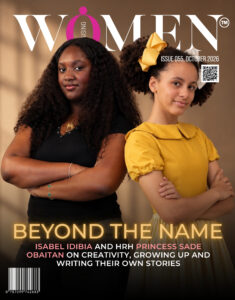
In Issue 55, our cover girls, Isabel Idibia and Princess Sade Obaitan, remind us that famous surnames and royal titles may introduce you, but they should never define you.

From girls conquering oceans and swimming pools to conversations about beauty, culture and ambition, this edition examines the expectations we inherit and the courage required to question them.

In Find Her Light, I also reflect on the careers I might have pursued and why discovering another gift does not invalidate the life we have already built.

Perhaps that is the lesson running through these pages: identity is not a finished manuscript.

Every girl deserves the freedom to write her own story. And every woman deserves another chapter.

Raising Women Magazine Issue 54 – October 2026

“Because you’re a girl.”
Four little words that have spent generations doing an extraordinary amount of damage. Apparently, ambition, intelligence and audacity were once considered rather unladylike.
Fortunately, the girls featured in our 54th edition missed that memo.
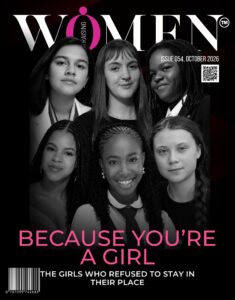
As we celebrate the International Day of the Girl Child, we spotlight twelve remarkable girls rewriting the rules, while reminding ourselves that a girl should not need extraordinary achievements to deserve ordinary opportunities.
We also explore the expectations that complicate girlhood, the childhood wounds we carry into adulthood and, in my Find Her Light reflection, why the girl I once was might have a few lessons for the woman I have become.
Perhaps our greatest responsibility is not simply raising girls to conquer the world, but ensuring they never have to shrink themselves to belong in it.
Because you’re a girl?
What a wonderful reason to dream without limits.

Your guide to IVF and egg freezing in Korea

Empowering your family planning journey with curated fertility treatments at lower costs. Get our guide for Korea’s leading clinics, pricing and service breakdown.

Recommended News

Raising Women Magazine Issue 56 – November 2026

The Courage to Question
We live in a world where reputation often arrives before character, popularity masquerades as goodness, and questioning authority can make you the problem. Apparently, being respected is sometimes mistaken for being beyond reproach.
Our cover woman, Rachael Denhollander, reminds us why that distinction matters. Her courage in confronting institutional abuse challenges us to reconsider what safety, justice and accountability truly mean.

Elsewhere, we explore the judgement surrounding childbirth, the invisible labour behind successful careers, the beauty industry’s obsession with perfection, and why women can cook the same meal as men yet receive considerably less applause.

From fashion and culture to relationships and motherhood, Issue 56 invites us to examine the assumptions we have inherited, including those we unknowingly perpetuate.

Because progress is not simply about celebrating extraordinary women. It is about creating a world where ordinary women and girls are heard, valued and protected.

And sometimes, change begins with refusing to look away.

Raising Women Magazine Issue 55 – October 2026

We spend a remarkable amount of time telling girls who they should become, often before they have finished discovering who they are. Apparently, growing up comes with a job description nobody remembers applying for.

In Issue 55, our cover girls, Isabel Idibia and Princess Sade Obaitan, remind us that famous surnames and royal titles may introduce you, but they should never define you.

From girls conquering oceans and swimming pools to conversations about beauty, culture and ambition, this edition examines the expectations we inherit and the courage required to question them.

In Find Her Light, I also reflect on the careers I might have pursued and why discovering another gift does not invalidate the life we have already built.

Perhaps that is the lesson running through these pages: identity is not a finished manuscript.

Every girl deserves the freedom to write her own story. And every woman deserves another chapter.

Raising Women Magazine Issue 54 – October 2026

“Because you’re a girl.”
Four little words that have spent generations doing an extraordinary amount of damage. Apparently, ambition, intelligence and audacity were once considered rather unladylike.
Fortunately, the girls featured in our 54th edition missed that memo.
As we celebrate the International Day of the Girl Child, we spotlight twelve remarkable girls rewriting the rules, while reminding ourselves that a girl should not need extraordinary achievements to deserve ordinary opportunities.
We also explore the expectations that complicate girlhood, the childhood wounds we carry into adulthood and, in my Find Her Light reflection, why the girl I once was might have a few lessons for the woman I have become.
Perhaps our greatest responsibility is not simply raising girls to conquer the world, but ensuring they never have to shrink themselves to belong in it.
Because you’re a girl?
What a wonderful reason to dream without limits.

Raising Women Magazine Issue 53 – September 2026

Apparently, saving the planet comes with a shopping list. Solar panels, electric cars, sustainable fashion and, preferably, a bank account that understands the assignment.

In Issue 53, our cover woman, Professor Joyashree Roy, challenges us to reconsider what sustainability really costs, who pays, and why the cheapest choices today may leave tomorrow’s generations with the bill.

But this issue is also about the invisible price tags attached to everyday life. From passport privilege and the cultural expectations of a “good woman” to motherhood, personal boundaries and the delicate art of enjoying life before finishing every task, we examine the systems shaping our choices.

We also celebrate women turning overlooked problems into extraordinary opportunities.

Perhaps progress begins when we stop asking only what things cost and start asking what they are worth.

A better world should not be a luxury reserved for those who can afford it.
Happy reading!

.

Raising Women Magazine Issue 52 – September 2026

This issue asks a deceptively simple question: can we save the planet without making ordinary people pay the highest price?
Our cover star, Sascha Gabizon, brings that question sharply into focus, challenging us to think about climate action not only through carbon, but through fairness, access and gender. Because going green sounds wonderful until sustainability becomes something only the wealthy can afford.
Across these pages, we follow climate change into unexpected places. Into our wardrobes, our food, our cultural traditions and even the price of our morning coffee. We also continue our important First Daughters conversation, explore what women really mean when they speak about safety, and look at 111 Miss World contestants whose purpose projects remind us that beauty today carries increasingly bigger expectations.
This edition is ultimately about responsibility, but responsibility shared fairly.
Because saving our planet cannot become another luxury.
And perhaps the greenest future is one everyone can actually afford.