by Emmanuella Abraham
For years, conversations about artificial intelligence in fashion have been dominated by fear. Fear that algorithms will replace designers. Fear that originality will disappear. Fear that fashion, an industry built on instinct and human perspective, could become automated into something cold and repetitive.
But at the Savannah College of Art and Design, a different conversation is taking shape.
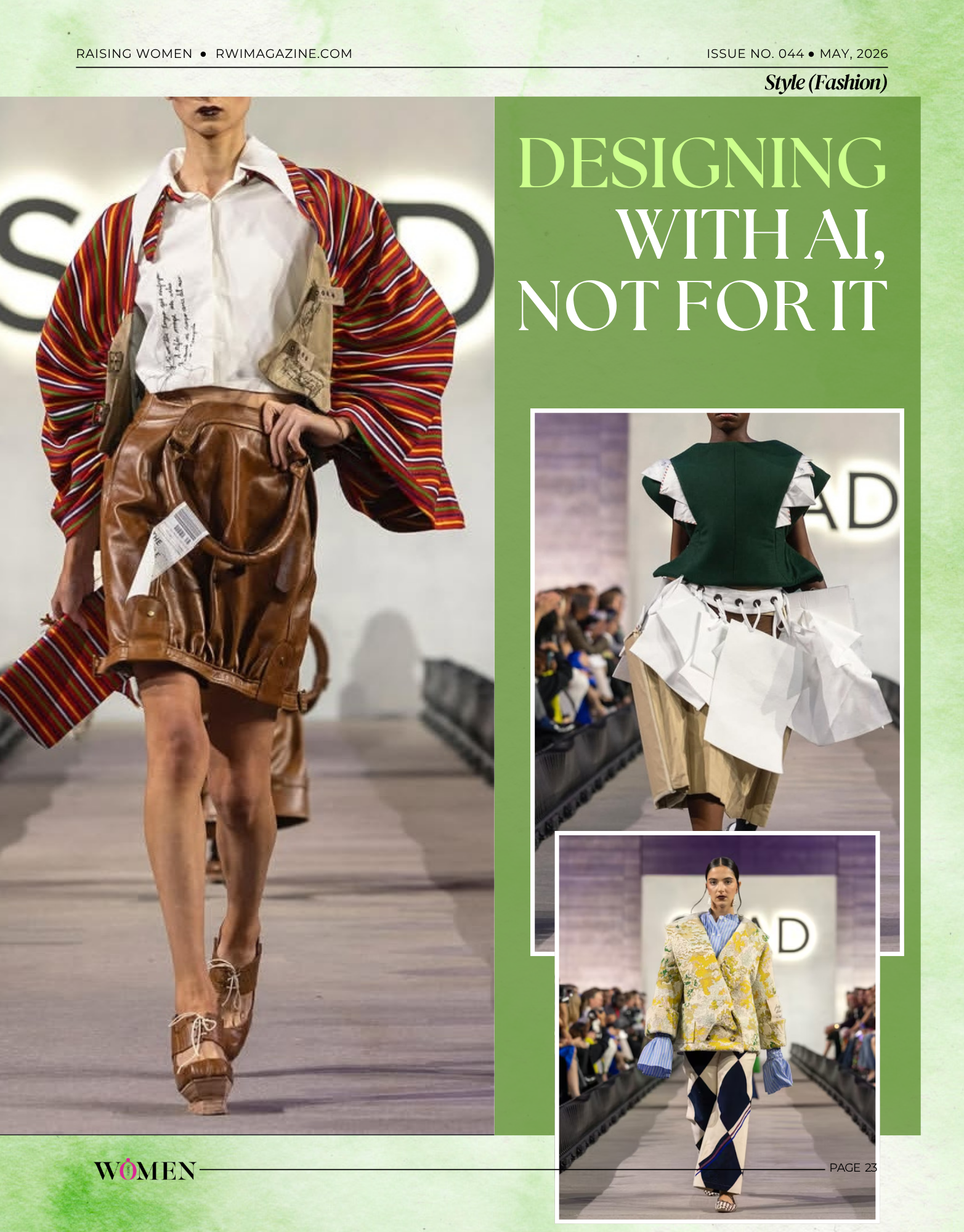
At this year’s SCAD fashion showcase, graduating designers presented collections that blended technology with something fashion still values deeply: craftsmanship. According to interviews surrounding the showcase, many students are not rejecting AI entirely, nor are they surrendering to it. Instead, they are using it selectively, strategically, and importantly, on their own terms.
That distinction matters.
Rather than allowing AI to dictate the creative process, several students described using it as a support tool. Designer Mollie Porch, for example, explained that she avoided using AI during ideation, choosing instead to rely on her own creative direction. She reportedly used technology later in the process for technical flats and production-related tasks rather than concept creation itself.
This reflects a larger shift happening across fashion education globally. Young designers increasingly see AI not as a replacement for creativity, but as infrastructure. Something that can accelerate repetitive tasks while leaving emotional and artistic decisions in human hands.
And perhaps that is why the SCAD showcase felt particularly relevant. The collections themselves remained tactile, personal, and emotionally specific. Students referenced abandoned churches in the American South, literary culture, personal histories, and handcrafted techniques. Even when digital tools appeared in the process, the final work still carried unmistakably human fingerprints.
There is also a growing awareness among emerging designers that fashion’s future may depend on learning how to balance both worlds. Ignoring AI entirely may become unrealistic in a rapidly digitising industry. But relying on it too heavily risks flattening the individuality fashion depends on.
SCAD itself appears to recognise this tension. Through AI summits, industry partnerships, and evolving coursework, the school has increasingly positioned AI as something students should understand critically, not blindly adopt.
What makes this new generation interesting is not their willingness to use technology. It is their refusal to let technology define them.
In an industry increasingly obsessed with speed and automation, these designers seem to be protecting something older and more fragile: creative identity.
And perhaps that is the real future of fashion. Not artificial intelligence replacing designers, but designers learning how to remain unmistakably human while working alongside it.