By Emmanuella Abraham & Daniel Agusi
There are women who speak because it is strategic. There are women who speak because it is necessary. And then there are women who speak because silence would cost more than consequence.
Farzana Faruk Jhumu belongs to the latter.
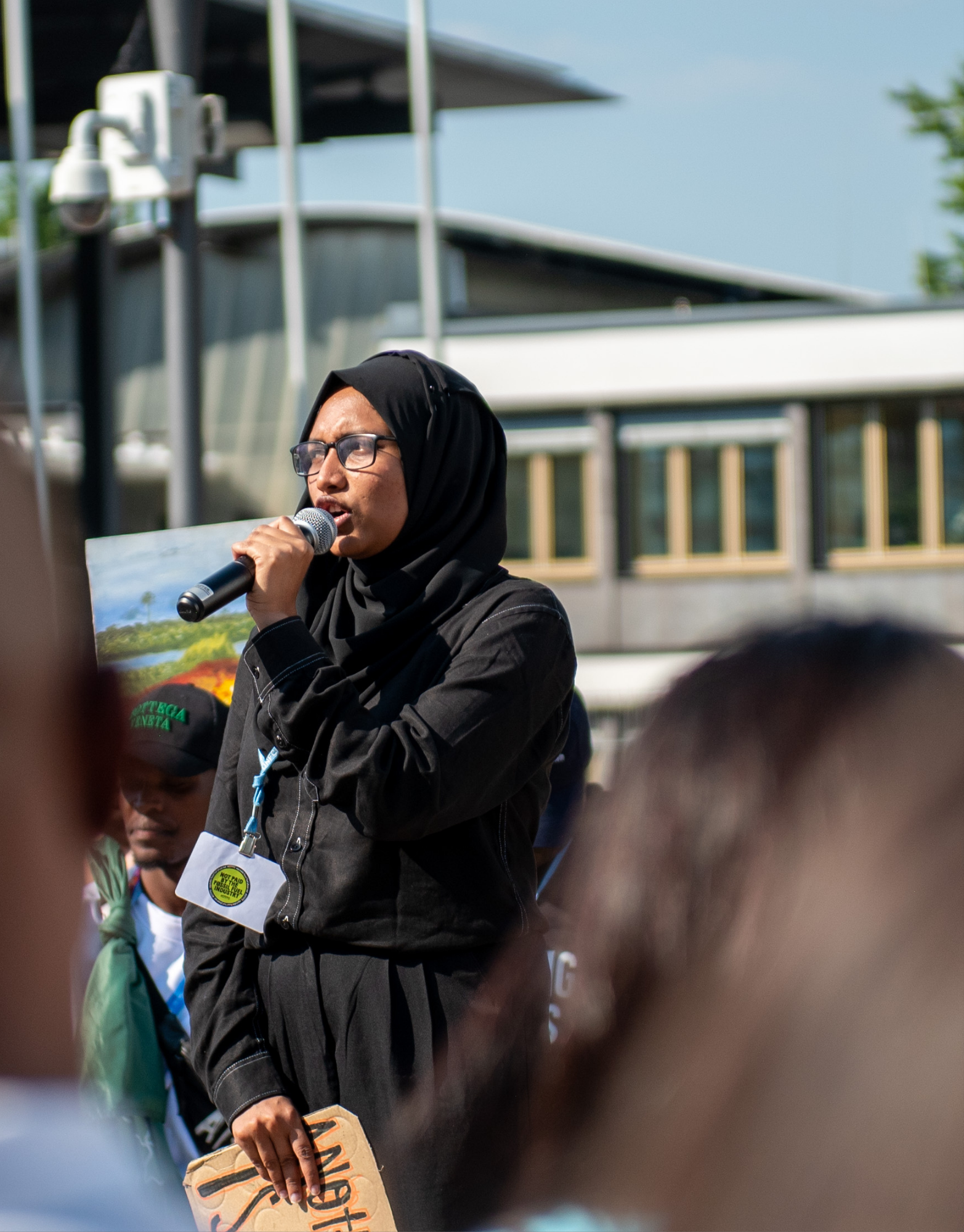
Based in Dhaka, Bangladesh, she serves as Youth Advisor on Climate Change to the United Nations Secretary-General. She is also a Regional Facilitator for the Youth Climate Justice Fund and the founder of the People’s Climate Diplomacy Programme, a youth-led, multi-stakeholder initiative that trains young people to engage directly in climate negotiations, not as observers, but as informed participants following the process alongside official parties.
But titles alone do not define her.
Her work sits at the intersection of climate justice, feminism, political power, colonial history, and lived vulnerability. She speaks not only about emissions and global warming, but about saline water altering reproductive health, girls forced into early marriage because of environmental collapse, and women walking for hours at night to fetch water after working all day.
For Farzana, climate change is not abstract. It is gendered. It is political. It is structural. And it is already here.
In this conversation, she speaks about voice as both responsibility and risk, about community as protection, about patriarchy within power structures, including among women and about what it truly costs to remain silent.
Q1. When did you first realise that speaking honestly as a woman would come with personal consequences, and how did that realisation shape the way you use your voice today?
Farzana:
“I would say my first realisation was not that speaking as a woman would bring consequences, but rather that not speaking as a woman would bring consequences.
I realised that while I was working as a volunteer, I also had certain privileges. Having access to education, which should be a basic right is still a privilege for many. I could speak English, which allowed me to connect with international spaces and knowledge. And then I realised I had to do something for society.
When I began volunteering, after some time I noticed that many people talk about women’s rights, but in practice, we do not have those rights. So, if I do not speak through a feminist lens, if I do not speak about women’s rights from the perspective of rights, care and resilience, then I am ignoring something personal and not just for myself, but for many women who cannot speak for themselves and are facing real issues.
If I remain silent despite having this privilege, that silence also has consequences. It has consequences for me, for the generation coming, and for many other women who are looking for someone to speak and act.
That was when I realised that I must speak. Because not speaking would also carry consequences.”
Q2. What do you think we misunderstand about visibility, especially for women speaking from conservative or hostile environments?
Farzana:
“I think when we talk about visibility, we often think about who speaks well, who can compete with men, who can match the dominant tone.
But visibility for women is not about becoming another version of men. It is not even about becoming another version of power. It is about not becoming a version of patriarchy.
If visibility requires a woman to abandon care, resilience or community in order to be recognised, then that visibility is simply reproducing patriarchy.
Sometimes we practise patriarchy just to prove that we also matter. But that is not liberation.”
Q3. How do you decide what to say publicly, knowing that silence can feel like safety, but speaking can feel like exposure?
Farzana:
“For me, it comes back to community.
I have a community that calls me in and calls me out. I make mistakes, and they correct me. This includes feminist organisations and my close female friends. Sometimes they tell me, ‘Farzana, what you said was wrong.’ And I accept that.
There are times when I say things that may not fully represent other vulnerable communities because I do not live their exact experiences. In those moments, they correct me, sometimes publicly, sometimes privately. That is how we learn from each other.
It is not about attacking one another. It is about creating better spaces for all of us.
Silence can feel like safety. I agree. But when you see people who are forced into silence, and you see others who continue speaking despite injustice and risk, then silence does not feel like safety anymore. It feels like cowardice.
I do not want a generation to look back and say that I chose safety over truth.”
Follow-Up: Has there been backlash? Have you ever regretted speaking out?
Farzana:
“Yes. Especially in policy spaces.
There are moments when it feels easier to agree with government officials. But sometimes I can see that they are aligning with fossil fuel interests under the argument of economic growth.
In those spaces, there is an inner voice saying, ‘Do not speak.’
But I know that if something serves corporate or fossil fuel interests rather than people, I cannot agree with it.
Sometimes I speak. Sometimes I do not. When I do not speak, I feel internal guilt. When I do speak, there is also tension. But most of the time, I choose to speak.”
Follow-Up: What gives you that courage?
Farzana:
“Part of my courage comes from knowing that I have some level of community protection. I know there are international climate networks that would respond if harm were directed at me.
Many women do not have that protection. They do not have anyone to back them up.
So sometimes my bravery comes from the fact that I know I am not completely alone.”
Q4. How can women reclaim their voices without sacrificing safety or wellbeing?
Farzana:
“This is a difficult question. If I could answer it fully, I would solve half of the world’s problems.
First, we are not listening to enough women. That is a major issue.
Second, education is critical. Education gives you the hunger to learn more. And when you learn about your rights, you begin to recognise injustice. If you do not know your rights, you may not even realise that something is unjust.
Another element is culture and community. In many Global South societies, including South Asia, community structures and religious traditions are complex. Within them, there are also histories of women in positions of power and decision-making.
Reclaiming voice sometimes means reclaiming those parts of culture that empower women, rather than accepting only the patriarchal interpretations.”
Q5. How does climate change intersect with gender, particularly for women in vulnerable communities?
Farzana:
“In coastal areas of my country, girls as young as 16 or 17 are being forced into marriage.
I once spoke to a mother who said her daughter must marry early because saline water has damaged reproductive health in the region. She believed that if her daughter waited until she was older, she might not be able to give birth, and then no one would marry her.
So, a mother is forcing her daughter into early motherhood because of environmental damage.
This is climate change.
Another example: women in some regions walk three hours at night to collect drinking water after working all day and caring for their families. They wait until midnight when the village sleeps. They lose sleep. This affects their health, their livelihood and the entire social system.
Climate change also increases mental load. When crops fail or cyclones come, women think not only of themselves but of children, animals, and family survival.
Climate change amplifies existing hierarchies and burdens.”
Follow-Up: Are we talking enough about this?
Farzana:
“If you look at the annual photographs from the Conference of Parties, you will see very few women among the decision-makers.
If women are not in decision-making spaces, issues like reproductive health impacts will not be prioritised.
So no, we are not talking enough.”
She adds:
“It is also not only about men. Women who reach power through the same patriarchal systems may also fail to understand grassroots struggles.
The voices we need to hear are the women directly affected.”
Q6. Why can climate conversations not be separated from women’s rights, poverty and political power?
Farzana:
“Climate change is not just about carbon or tree planting.
It is about who is impacted.
My country produces only 0.3 percent of global carbon emissions, yet we are among the top ten most vulnerable countries.
We must ask who emitted most, and who benefited from colonisation and resource extraction.
If greed is at the root of climate destruction, poverty and corruption, then the solution must address that root.
If we treat climate change as an isolated environmental issue, we miss the point. These systems are interconnected.”
Q7. How do you protect your inner life while doing publicly contested work?
Farzana:
“Again, community.
In my community, we talk about justice and patriarchy. But we also talk about lipstick, which colour to buy and things like that.
It is important to remember that activism does not remove joy or everyday life.
I also remind myself that this is purpose-driven work. I am not doing it for visibility. I am not doing it only for payment. Though I must earn to survive, but there is also passion.
With opportunity comes responsibility.”
Q8. What would you say to a woman who feels her voice is too small or risky?
Farzana:
“I would say: start by whispering.
Even a whisper is a sound.
There are situations where silence may be necessary for survival, and we must respect those women.
But feminism is about care, connectivity and community. When one woman cannot speak, others can help amplify her voice.
It is not competition with men. It is about our lives.”
The First Daughter Question
We often speak of the “first daughter” as a role rather than a birth order, shaped by early responsibility, emotional labour, and expectation. In what ways have you carried this role in your life, and how has it shaped the person you have become?
Farzana:
“As a first daughter, there were more expectations placed on me than on my siblings.
My parents were conscious of raising a girl in a difficult world. My father did not raise me as a princess. He raised me to be strong and practical.
I learned early about safety, about navigating the world carefully. That shaped me to be focused and intentional.
Even now, there is a dynamic of responsibility between siblings. My brother calls me for advice. My younger sister and I share responsibilities, sometimes I handle finances, sometimes she supports me in other ways.
Being the first daughter meant learning resilience early.”