By Akpokugbere Sandra
Long before luxury became algorithmic, these businesses began as family workshops. Small leather stores. Fur ateliers. Shoe benches. Tiny rooms carrying ambition through war, grief, inheritance, and generations. Today, many of those same empires are being protected, modernised, and culturally redefined by women.
What follows is not a story about succession. It is a story about the particular weight of a name and what it takes to carry it into another century.
PRADA FOUNDED 1913 IN MILAN
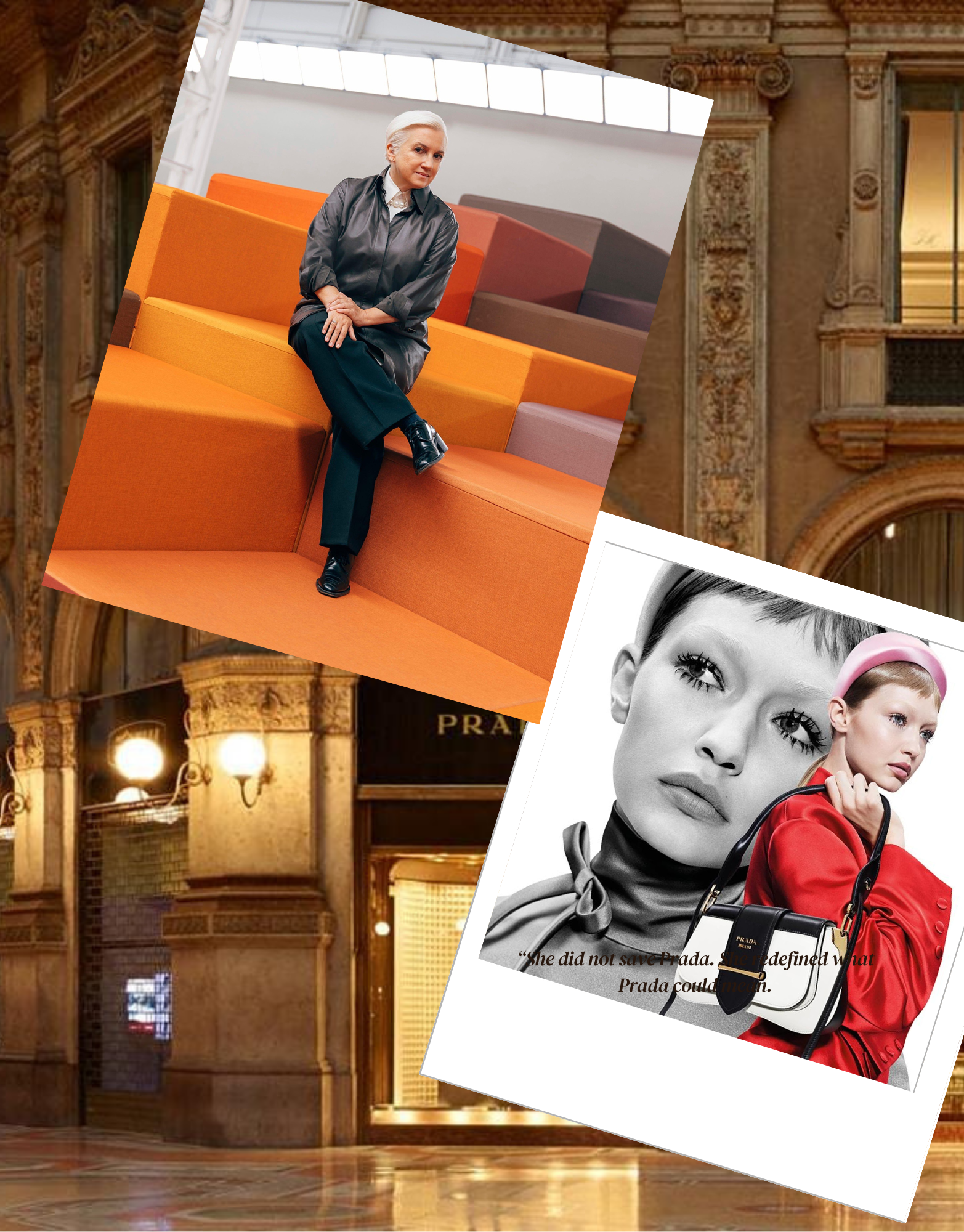
History would eventually turn ironic. Mario Prada founded his leather goods house in Milan in 1913 and reportedly believed women had no place in business. His son had no interest in the company either. So it was Mario’s daughter, Luisa, who stepped in as head of the house in 1958. When Luisa retired in 1978, the company passed to her daughter Miuccia, a doctorate holder in political science, a trained mime, and a former member of the Italian Communist Party.
What Miuccia did next was not save Prada. It was redefine what Prada could mean. Her line of unlabelled military-grade nylon backpacks was met with scepticism. By 1985, redesigned with the iconic triangular logo, they became one of fashion’s most copied silhouettes. Her 1988 ready-to-wear debut established her as a designer of genuine intellectual force: minimalism as subversion, restraint as rebellion. Under her leadership, the Prada Group grew to include Miu Miu, Church’s, Car Shoe, and in 2025, Versace, acquired for €1.25 billion. The empire she inherited was worth $450,000. Today it is valued at $19 billion.
“She did not save Prada. She redefined what Prada could mean.
FERRAGAMO FOUNDED 1927 IN FLORENCE
62. Wanda was 38, with six children at home, the youngest just two years old, and had never worked a day outside the home. “In those early days I felt an energy like a lion,” she would later say. “Everyone was surprised, but I realised it was no use to be alone crying about my destiny.”
Wanda understood that a mono-product brand would not survive on heritage alone. She expanded Ferragamo from a shoemaker into a full fashion house, adding scarves, fragrances, handbags, and ready-to-wear, while growing production from 6,500 pairs a year to over 10,000 pairs per day. She rejected multiple acquisition offers, insisting the business remain in family hands, and steered its first public stock offering in 2011. She died in October 2018 at 96, still going into the office in her final years.
“I had never worked in my life before my husband died,” she told Time magazine in 2007. “In those early days I felt an energy like a lion. Everyone was surprised, but I realised it was no use to be alone crying about my destiny.”
FENDI FOUNDED 1925 IN ROME
Fendi was founded not in a boardroom but in a small Roman fur and leather boutique, opened in 1925 by Adele Casagrande. When she married Edoardo Fendi, the shop became a family house. Their five daughters, Paola, Anna, Franca, Carla, and Alda, joined the business through the 1940s and ’50s, each taking ownership of a different facet: the atelier, the accessories, and the business development. Female leadership at Fendi was never a disruption. It was the founding logic.
Silvia Venturini Fendi, daughter of Anna and granddaughter of Adele, entered the house in 1992 alongside Karl Lagerfeld, the longest designer-house collaboration in fashion history. She became head of accessories and menswear in 1994, and it was there that she changed the course of luxury forever.
In 1997, Silvia designed the Fendi Baguette, a small, compact shoulder bag meant to be tucked under the arm like its French namesake. It became the first true “It bag,” a concept the industry had not yet named but would spend the next three decades chasing. When Carrie Bradshaw was robbed at gunpoint in Sex and the City and corrected the mugger, “It’s not a bag, it’s a Baguette“, the cultural coronation was complete. The bag’s success was so significant it helped attract LVMH, who acquired a majority stake in Fendi in 2001.
In 2009, Silvia designed the Peekaboo. In 2025, Fendi’s centennial year, she oversaw both women swear and menswear, steering the house through its 100th anniversary with a collection that brought her twin grandsons onto the runway in looks that mirrored outfits Lagerfeld had once made for her at the same age.
These women did not simply inherit businesses. They inherited pressure. Expectation. Legacy. Entire family names stitched into leather, silk, craftsmanship, and memory.
What distinguishes them is not that they preserved these houses. It is how they enlarged them, expanding the definition of what a luxury brand could be, who it could speak to, what it could mean beyond the product itself.