Spotlighting Remarkable Women and Girls

The AI Economy Has a Gender Problem: The future of work is being built fast, women are still being left behind.

by Emmanuella Abraham

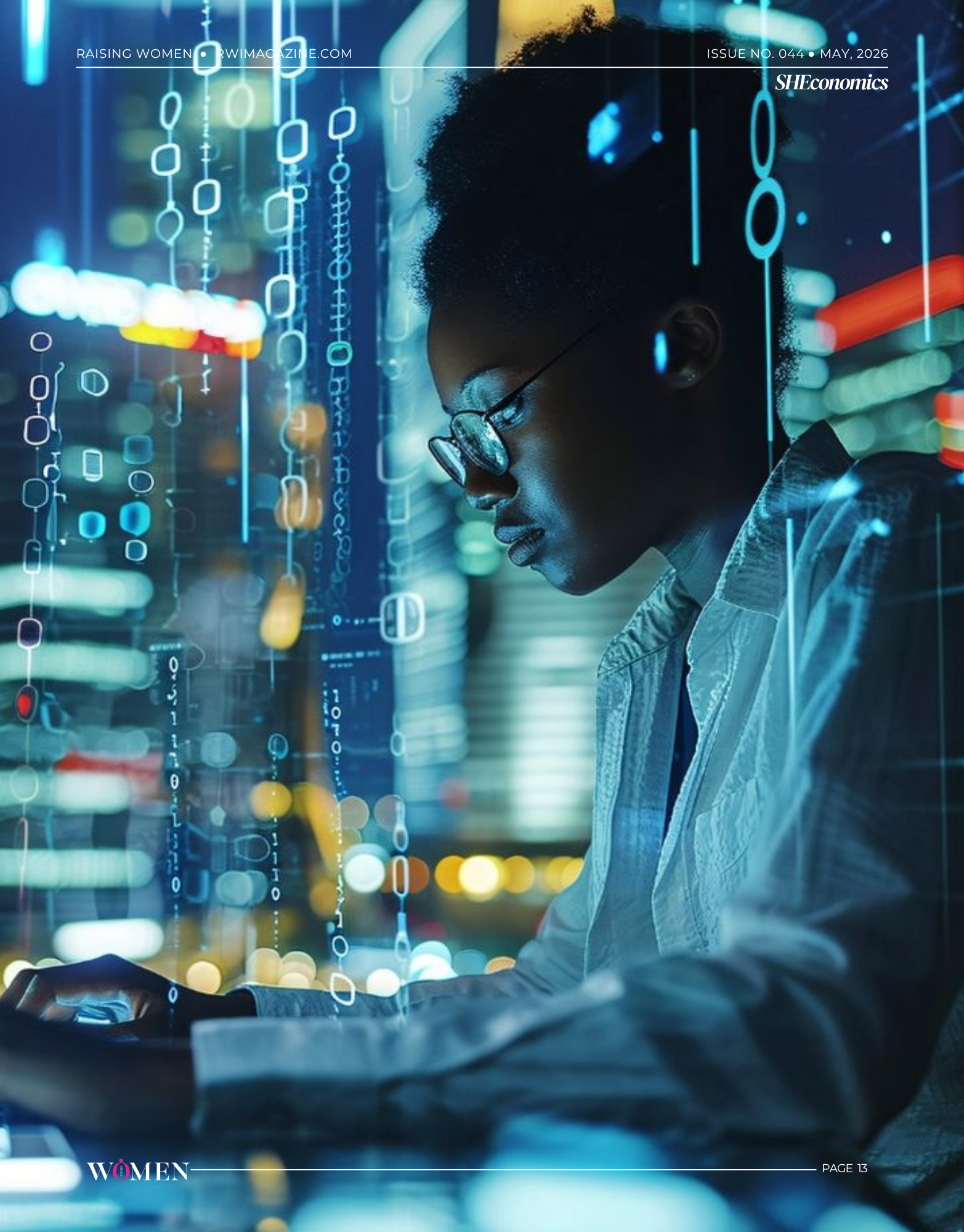
Artificial intelligence is often framed as the next great economic revolution. Governments are investing in it, companies are restructuring around it, and workers across industries are being told to adapt quickly or risk becoming irrelevant. But beneath the excitement sits a quieter reality: the AI economy is not unfolding evenly, and women may be carrying a disproportionate share of the disruption.

Recent data from the International Labour Organization found that jobs traditionally occupied by women are significantly more exposed to generative AI systems than those primarily held by men. Administrative work, customer support, scheduling, coordination, clerical roles, and certain communication-based tasks are among the professions most likely to be transformed or partially automated in the coming years.

This matters because these are not marginal jobs. Globally, millions of women work within precisely these sectors. In many economies, especially across developing regions, women are overrepresented in support and service positions that businesses increasingly view as “automatable.”

The issue is not simply job loss. It is job restructuring.

AI is unlikely to eliminate work entirely overnight. What it is already doing is changing the value of certain skills. Tasks once considered essential are becoming faster, cheaper, and increasingly machine-assisted. The workers most vulnerable are often those with limited access to digital upskilling, technical training, or decision-making power within organisations. Women, particularly in lower and middle-income economies, frequently fall into that category.

At the same time, women remain underrepresented in the industries shaping AI itself. According to reports from organisations such as UNESCO and the World Economic Forum, women continue to make up a significantly smaller percentage of the global AI and technology workforce. Leadership gaps are even wider. This creates an imbalance where systems influencing the future of labour are often designed without broad female representation at the table.

The consequences extend beyond employment statistics. AI systems learn from existing data, and existing data reflects social bias. Researchers have repeatedly found that algorithms can reproduce discrimination related to hiring, pay, promotion, and visibility if not intentionally corrected. When women are absent from development and oversight, those biases become harder to identify and challenge.

There is also a financial divide emerging around access to AI tools themselves. While large corporations are rapidly integrating automation systems, smaller businesses and independent workers often struggle to keep pace. This is particularly relevant for women entrepreneurs, freelancers, and informal sector workers who may lack the capital, infrastructure, or technical support needed to compete in an AI-driven market.

Yet the conversation is not entirely pessimistic.

Some economists argue that AI may ultimately increase demand for deeply human skills rather than replace them entirely. Emotional intelligence, caregiving, communication, education, strategy, and community-based work remain difficult to automate effectively. Ironically, many of the areas historically undervalued within economies are now becoming more economically significant precisely because machines struggle to replicate them authentically.

There is also evidence that women are increasingly entering digital entrepreneurship spaces, using AI tools for content creation, business operations, research, and independent income generation. The challenge is not capability. It is access, inclusion, and speed of adaptation.

The real risk is not that women cannot participate in the AI economy. It is that they are being asked to adapt to systems they had limited influence in building.

This is why conversations about AI cannot remain purely technological. They are economic conversations, labour conversations, and increasingly, gender conversations. Questions about who gets trained, who gets funded, whose jobs are protected, and who shapes policy will determine whether AI expands inequality or helps reduce it.

What happens next depends largely on whether institutions move quickly enough. Governments, companies, and educational systems will need to invest aggressively in digital literacy, workforce transition programmes, and inclusive hiring pipelines. Without intentional intervention, automation risks reinforcing existing economic imbalances rather than correcting them.

The future of work is already arriving. The question is whether women will merely adjust to it or actively help shape it.

Share:

Trending

Raising Women Magazine Issue 046 – June 2026

There is something deeply revealing about the way a society treats its children. Not just in policy or parenting, but in the stories it tells them, the spaces it creates for them, and the kind of world it quietly prepares them to inherit. In this Children’s Day edition, Raising Women Magazine turns its attention to childhood itself, not as a sentimental phase of life, but as the foundation upon which identity, confidence, memory, and humanity are built.

Our cover star, Ms. Rachel, represents a refreshing reminder that gentleness still matters in an age of noise. Through patience, intentionality, and emotional safety, she has transformed songs and screen time into a global classroom for millions of children and families.

Across this issue, we explore the emotional architecture of childhood, from the girls who learn too early to shrink themselves, to the children quietly carrying adult burdens before they fully understand their own. We also interrogate modern parenting, digital culture, family, safety, and the futures young people are already shaping.

Because childhood is never just preparation for life.

In many ways, it is life itself.

Raising Women Magazine Issue 045 – June 2026

There is a difference between living and merely functioning.
Somewhere between the notifications, deadlines, responsibilities, ambitions, and endless demands of modern life, many of us have become exceptionally good at keeping going. We show up. We deliver. We carry. We cope. Yet beneath the appearance of productivity, an important question remains: are we truly well?
In this issue of Raising Women Magazine, we explore wellness not as a trend, but as a deeper conversation about humanity, health, purpose, and presence.
Our cover feature introduces Dr. Heidi Beilis, a pioneering physician helping to shape the future of healthcare through artificial intelligence. Her work reminds us that innovation is at its best when it serves people, particularly women whose lives may be transformed by earlier diagnoses and better outcomes.
Elsewhere, we explore grief, ambition, beauty, leadership, healthspan, rest, and the invisible burdens many women carry. We ask difficult questions about what it means to thrive, not simply survive.
As I wrote in this issue’s Find Her Light column, sometimes the rest we need is not sleep. Sometimes it is space. Sometimes it is perspective. Sometimes it is permission.
May these pages offer all three.

POETRY

by The Lulu I miss my childhood. I miss the version of me that laughed from the stomach, that ran barefoot without worrying about tomorrow,

Your guide to IVF and egg freezing in Korea

Empowering your family planning journey with curated fertility treatments at lower costs. Get our guide for Korea’s leading clinics, pricing and service breakdown.

Recommended News

Raising Women Magazine Issue 046 – June 2026

There is something deeply revealing about the way a society treats its children. Not just in policy or parenting, but in the stories it tells them, the spaces it creates for them, and the kind of world it quietly prepares them to inherit. In this Children’s Day edition, Raising Women Magazine turns its attention to childhood itself, not as a sentimental phase of life, but as the foundation upon which identity, confidence, memory, and humanity are built.

Our cover star, Ms. Rachel, represents a refreshing reminder that gentleness still matters in an age of noise. Through patience, intentionality, and emotional safety, she has transformed songs and screen time into a global classroom for millions of children and families.

Across this issue, we explore the emotional architecture of childhood, from the girls who learn too early to shrink themselves, to the children quietly carrying adult burdens before they fully understand their own. We also interrogate modern parenting, digital culture, family, safety, and the futures young people are already shaping.

Because childhood is never just preparation for life.

In many ways, it is life itself.

Raising Women Magazine Issue 045 – June 2026

There is a difference between living and merely functioning.
Somewhere between the notifications, deadlines, responsibilities, ambitions, and endless demands of modern life, many of us have become exceptionally good at keeping going. We show up. We deliver. We carry. We cope. Yet beneath the appearance of productivity, an important question remains: are we truly well?
In this issue of Raising Women Magazine, we explore wellness not as a trend, but as a deeper conversation about humanity, health, purpose, and presence.
Our cover feature introduces Dr. Heidi Beilis, a pioneering physician helping to shape the future of healthcare through artificial intelligence. Her work reminds us that innovation is at its best when it serves people, particularly women whose lives may be transformed by earlier diagnoses and better outcomes.
Elsewhere, we explore grief, ambition, beauty, leadership, healthspan, rest, and the invisible burdens many women carry. We ask difficult questions about what it means to thrive, not simply survive.
As I wrote in this issue’s Find Her Light column, sometimes the rest we need is not sleep. Sometimes it is space. Sometimes it is perspective. Sometimes it is permission.
May these pages offer all three.

POETRY

by The Lulu I miss my childhood. I miss the version of me that laughed from the stomach, that ran