Spotlighting Remarkable Women and Girls

The Desk Is Not Neutral- Living Segment

By Emmanuella Abraham

How women are redesigning power, one workspace at a time.

For a long time, the desk was treated as a purely functional object. A flat surface, a chair, a place to work. But that assumption has quietly shifted. Today, the desk is no longer neutral. It is expressive, intentional, and increasingly, a reflection of how women see their work and themselves.

The change is not aesthetic alone. It is structural. Research from organisations such as Harvard Business Review and McKinsey & Company has consistently shown that workspace design influences focus, decision-making, and overall productivity. Lighting, layout, and visual order are not secondary details. They shape how work is done.

As more women move into flexible and independent work structures, especially post-pandemic, the home workspace has become a site of control. It is one of the few environments where both function and identity can be designed without compromise. The result is a shift away from generic setups toward spaces that feel considered.

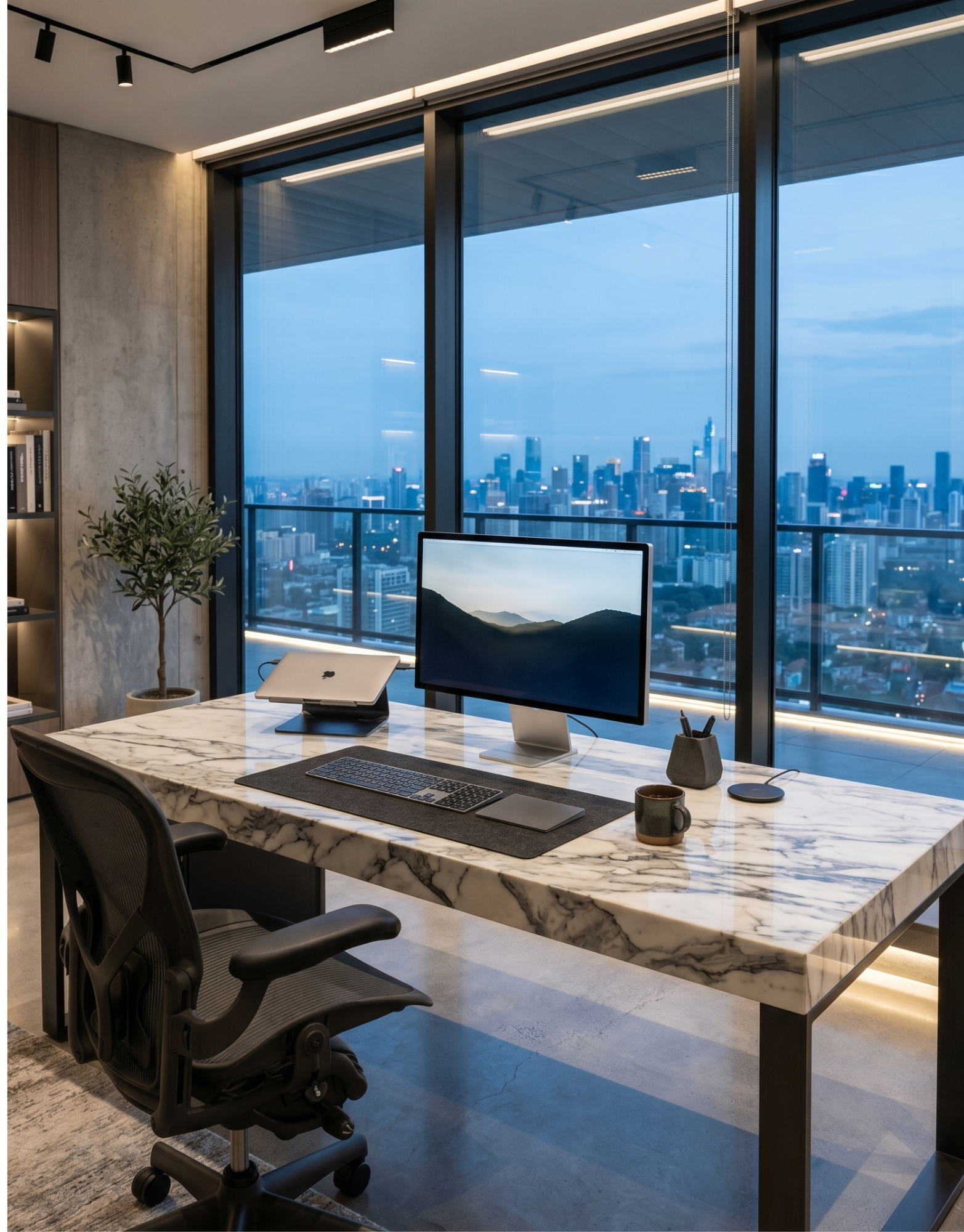
There is a pattern emerging. Desks are cleaner, but not empty. Objects are selected, not accumulated. A stack of books signals thought. A plant introduces softness. Materials matter. Wood, stone, glass. Each element contributes to an atmosphere that supports sustained attention without feeling clinical.

This attention to detail is not about perfection. It is about clarity. Visual clutter competes for cognitive space, and reducing it can improve focus. Studies in environmental psychology have linked organised workspaces to improved task completion and lower stress levels. The desk becomes less about decoration and more about removing friction from the work itself.

There is also a quiet assertion of ownership. Historically, workspaces, especially formal ones, have been designed with uniformity in mind. Personalisation was limited. Now, particularly in private or hybrid work settings, women are reclaiming that space. The desk becomes a place where aesthetics and authority can coexist.

Technology plays a role, but it is increasingly integrated rather than dominant. Laptops, tablets, and accessories are styled into the environment rather than defining it. The emphasis is on balance. Function remains central, but it is supported by an environment that feels stable and intentional.

What is most interesting is how subtle the shift appears from the outside. A well-placed lamp, a carefully chosen chair, a restrained colour palette. None of these are dramatic on their own. But together, they create a workspace that signals something different. Not just productivity, but presence.

The modern desk is no longer just where work happens. It is where decisions are shaped, where ideas are built, and where a certain kind of authority is quietly expressed.

Share:

Trending

Raising Women Magazine Issue 045 – June 2026

There is a difference between living and merely functioning.
Somewhere between the notifications, deadlines, responsibilities, ambitions, and endless demands of modern life, many of us have become exceptionally good at keeping going. We show up. We deliver. We carry. We cope. Yet beneath the appearance of productivity, an important question remains: are we truly well?
In this issue of Raising Women Magazine, we explore wellness not as a trend, but as a deeper conversation about humanity, health, purpose, and presence.
Our cover feature introduces Dr. Heidi Beilis, a pioneering physician helping to shape the future of healthcare through artificial intelligence. Her work reminds us that innovation is at its best when it serves people, particularly women whose lives may be transformed by earlier diagnoses and better outcomes.
Elsewhere, we explore grief, ambition, beauty, leadership, healthspan, rest, and the invisible burdens many women carry. We ask difficult questions about what it means to thrive, not simply survive.
As I wrote in this issue’s Find Her Light column, sometimes the rest we need is not sleep. Sometimes it is space. Sometimes it is perspective. Sometimes it is permission.
May these pages offer all three.

Raising Women Magazine Issue 044 – May 2026

There is something deeply revealing about the way a society treats its children. Not just in policy or parenting, but in the stories it tells them, the spaces it creates for them, and the kind of world it quietly prepares them to inherit. In this Children’s Day edition, Raising Women Magazine turns its attention to childhood itself, not as a sentimental phase of life, but as the foundation upon which identity, confidence, memory, and humanity are built.

Our cover star, Ms. Rachel, represents a refreshing reminder that gentleness still matters in an age of noise. Through patience, intentionality, and emotional safety, she has transformed songs and screen time into a global classroom for millions of children and families.

Across this issue, we explore the emotional architecture of childhood, from the girls who learn too early to shrink themselves, to the children quietly carrying adult burdens before they fully understand their own. We also interrogate modern parenting, digital culture, family, safety, and the futures young people are already shaping.

Because childhood is never just preparation for life.

In many ways, it is life itself.

The Family Tree Divide

What Women Are Given, and What They Build By Sipho Khumalo Two women walk into the same room. One is recognised before she speaks. The

Your guide to IVF and egg freezing in Korea

Empowering your family planning journey with curated fertility treatments at lower costs. Get our guide for Korea’s leading clinics, pricing and service breakdown.

Recommended News

Raising Women Magazine Issue 045 – June 2026

There is a difference between living and merely functioning.
Somewhere between the notifications, deadlines, responsibilities, ambitions, and endless demands of modern life, many of us have become exceptionally good at keeping going. We show up. We deliver. We carry. We cope. Yet beneath the appearance of productivity, an important question remains: are we truly well?
In this issue of Raising Women Magazine, we explore wellness not as a trend, but as a deeper conversation about humanity, health, purpose, and presence.
Our cover feature introduces Dr. Heidi Beilis, a pioneering physician helping to shape the future of healthcare through artificial intelligence. Her work reminds us that innovation is at its best when it serves people, particularly women whose lives may be transformed by earlier diagnoses and better outcomes.
Elsewhere, we explore grief, ambition, beauty, leadership, healthspan, rest, and the invisible burdens many women carry. We ask difficult questions about what it means to thrive, not simply survive.
As I wrote in this issue’s Find Her Light column, sometimes the rest we need is not sleep. Sometimes it is space. Sometimes it is perspective. Sometimes it is permission.
May these pages offer all three.

Raising Women Magazine Issue 044 – May 2026

There is something deeply revealing about the way a society treats its children. Not just in policy or parenting, but in the stories it tells them, the spaces it creates for them, and the kind of world it quietly prepares them to inherit. In this Children’s Day edition, Raising Women Magazine turns its attention to childhood itself, not as a sentimental phase of life, but as the foundation upon which identity, confidence, memory, and humanity are built.

Our cover star, Ms. Rachel, represents a refreshing reminder that gentleness still matters in an age of noise. Through patience, intentionality, and emotional safety, she has transformed songs and screen time into a global classroom for millions of children and families.

Across this issue, we explore the emotional architecture of childhood, from the girls who learn too early to shrink themselves, to the children quietly carrying adult burdens before they fully understand their own. We also interrogate modern parenting, digital culture, family, safety, and the futures young people are already shaping.

Because childhood is never just preparation for life.

In many ways, it is life itself.

The Family Tree Divide

What Women Are Given, and What They Build By Sipho Khumalo Two women walk into the same room. One is

First, Believe

By The Lulu They said the sky’s the limit But what if you’re still underground, still digging through the dirt