By Saneta Thomas
On the evening of 7 April 2026, the United States and Iran agreed to a two-week ceasefire, brokered by Pakistan. As a key condition, Iran committed to coordinating the reopening of the Strait of Hormuz to international shipping. Oil prices fell more than 17% on the news, and stock markets rallied across Asia on 8 April. However, shipping experts caution that only a handful of vessels have transited the strait so far, and hundreds of tankers remain trapped in the Persian Gulf. IATA’s director general confirmed it will take “a period of months” not weeks, for jet fuel supply and prices to normalise, given lasting damage to refining capacity across the region. The ceasefire is fragile and covers only two weeks. The analysis, predictions, and human consequences outlined in this article remain fully in effect. The crisis is entering a new phase, it has not ended.
There is a phrase that economists use in calm times: “energy is an input cost.” It is the kind of language that belongs in a quarterly report, far removed from everyday life. In April 2026, that phrase has been replaced by something more visceral. Energy is now a survival question, for nations, for businesses, for families, and most of all, for the most vulnerable people on earth.
The closure of the Strait of Hormuz, triggered by the war in Iran that began on 28 February 2026, set off a chain reaction that has reached every corner of the global economy. Oil prices surged past $120 a barrel. Fertiliser costs spiked 46 percent in a single month. Fuel rationing has been implemented in more than 30 countries.
And as supply chains buckle and inflation bites, the real cost of this crisis is landing not in boardrooms, but in kitchens, classrooms, and households managed, overwhelmingly, by women.
Do you know?
45 Millon of the World Food Programme estimates could face acute hunger by mid-2026 due to disrupted fertiliser and supply chains.
46% of the Month-on-month spike in urea fertiliser prices between February and March 2026, directly threatening the next global planting season.
$2.2T was invested in clean energy technologies in 2025, the crisis is now making that investment look not just smart, but urgent.
30+ Countries implementing fuel rationing, emergency measures or work-from-home mandates as of April 2026.
Crisis Snapshot
Strait of Hormuz | Closed to most traffic since 4 March 2026, disrupting 20% of world’s daily oil supply.
Brent Crude | Peaked at $120/barrel in March; WTI surging past $111
Jet Fuel | Near-tripled from $83 to $230+ per barrel since January
Food Prices | FAO Food Price Index up 2.4% in March; wheat up 7% year-on-year.
IEA Warning | Called it “the greatest global energy security challenge in history”
Goldman Sachs | Warns of “worst oil crisis on record”; Energy sector ETF up 33% YTD.
What this Means for Women
Energy crises have never been gender neutral and they never will be. When fuel becomes scarce and prices surge, the burden of adjustment falls first and heaviest on women, and this 2026 crisis is no different. What is different is the scale, the speed, and the global reach of the impact.
The household economy is under assault: Food prices are rising across every category. The World Bank’s commodity data shows urea, the primary fertilizer that keeps global food produ-ction running, spiked 46 percent between February and March 2026 alone. Wheat prices are 7 percent higher year-on-year. Cereals overall rose 13 percent since December 2025. Women, who manage the majority of household budgets in both developed and developing economies, are the first to feel the arithmetic of a food basket that costs more every week.
Transport access for women is shrinking: From the Philippines, where domestic and regional flights have been suspended, to Bangladesh, where fuel-driven transport strikes have left commuters stranded, women’s access to mobility is being clipped. For women who travel to work, access health services, or run businesses that depend on logistics, this is not an inconvenience. It is a barrier.
The Informal Economy Is Where Women Will Hurt Most
Globally, women make up the majority of workers in the informal economy, street trading, domestic work, market vending, and small-scale agriculture. These livelihoods have no “work from home” option. They run on physical mobility, on affordable transport, on the ability to move goods. When fuel prices double and transport routes collapse, the informal economy does not slow down gracefully. It hemorrhages income, almost invisibly, for millions of women who have no institutional safety net to catch them.
In contrast, professional women in the formal economy, particularly in office-based roles may find that work-from-home mandates now being issued across the Philippines, Thailand, Vietnam, and elsewhere offer a degree of flexibility. But flexibility without infrastructure, reliable electricity, broadband, a safe home workspace is its own form of inequality. Women in smaller homes, with children, with caregiving responsibilities, do not experience WFH as liberation. They experience it as the collision of two full-time jobs in the same four walls.
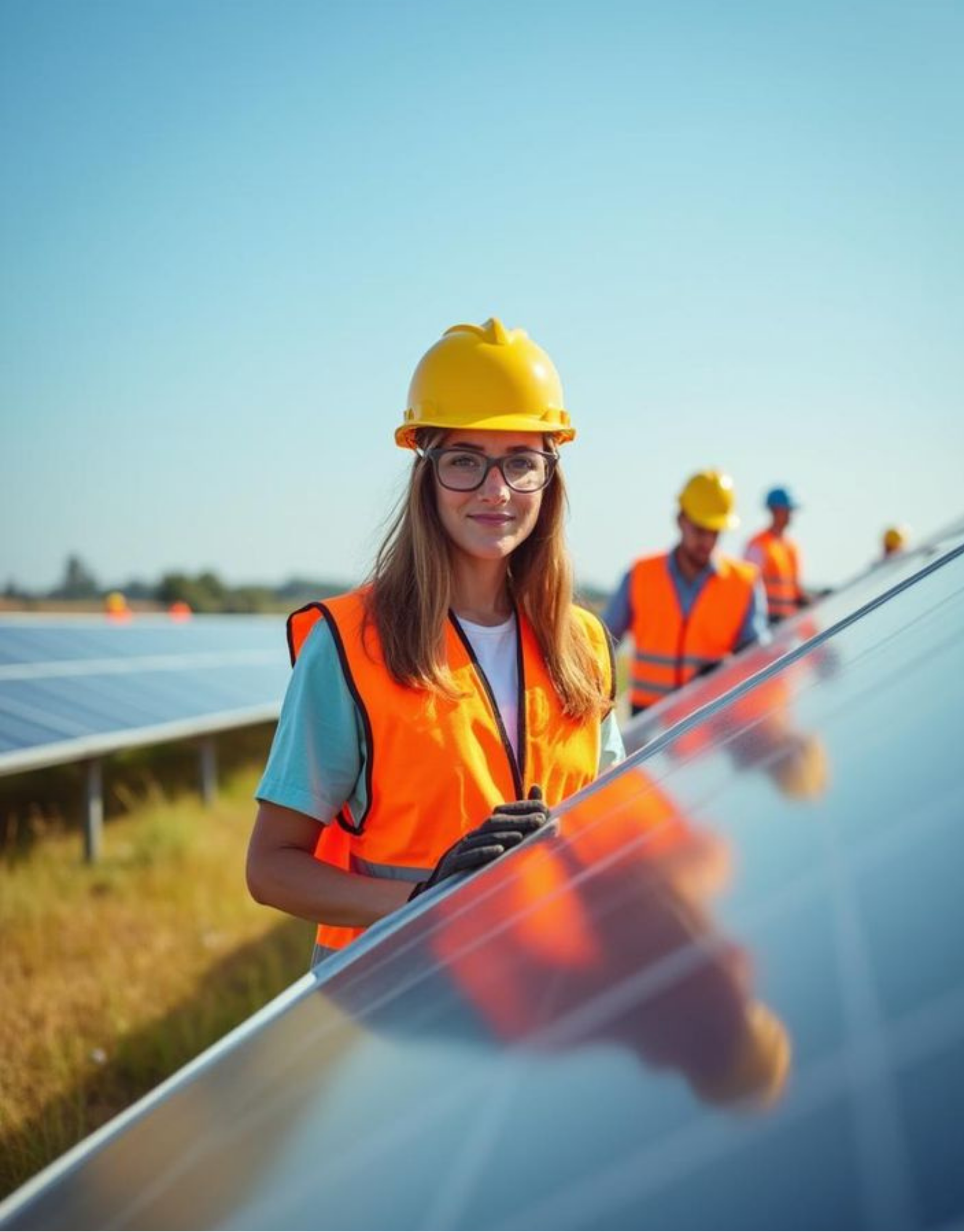
The renewable energy opportunity for women-owned businesses is real. But it requires capital now. Countries and communities that invest in solar, home batteries, and distributed energy systems in the next 12 months will be building resilience that protects households and especially women-managed households, from the next crisis.
Women entrepreneurs who move into clean energy solutions, energy efficiency consulting, or renewable supply chains are not just building businesses. They are building infrastructure that their communities will desperately need.
What this Means for ChildrenChildren do not choose the world they are born into. They do not set fertiliser prices or close shipping straits. And yet, in every major energy and economic crisis in modern history, children have paid the highest price in stunted growth, in lost schooling, in hunger that does not simply pass when the crisis does.
The World Food Programme estimates the Middle East conflict could push 45 million additional people into acute hunger by mid-2026. UNICEF’s 2026 Global Outlook warns that the climate and energy crisis is “altering children’s lives through food insecurity, health and disease burdens, displacement, and educational disruption.” These are not hypothetical risks. They are already unfolding.
School closures are compounding educational loss. Bangladesh closed its universities as one of its first crisis responses. Sri Lanka moved to four-day school weeks. These measures conserve fuel, but at the cost of learning time for children who, in many of these countries, are already behind. Research published in early 2026 confirms that major economic price shocks are not merely temporary setbacks for children: they correlate with increased rates of chronic malnutrition and child stunting that persist into adulthood.
Fertiliser shortages threaten the next harvest. The Persian Gulf is a key source of fertilisers for global agriculture. With supply routes disrupted and urea prices spiking, farmers across Africa and Asia are planting less and fertilising less. For children in low-income households, this matters viscerally: lower crop yields mean higher food prices in 6 to 12 months. The food security shock from this crisis has not yet fully arrived. It is still growing.
Healthcare delivery is being disrupted. Humanitarian organisations including WFP and UNICEF have warned that longer shipping routes and congestion are delaying the delivery of medical supplies and food aid. Fuel shortages directly affect the vehicles that deliver vaccines, the generators that power clinics, the refrigeration chains that keep medicines viable. In conflict-affected and fragile states, these disruptions are life-threatening.
“Children bear these burdens first and will carry them the longest. The choices made in 2026 will shape their futures, whether we act with urgency or wait until the harm is irreversible.” — UNICEF Prospects for Children: Global Outlook 2026
What It Means for Business and the World
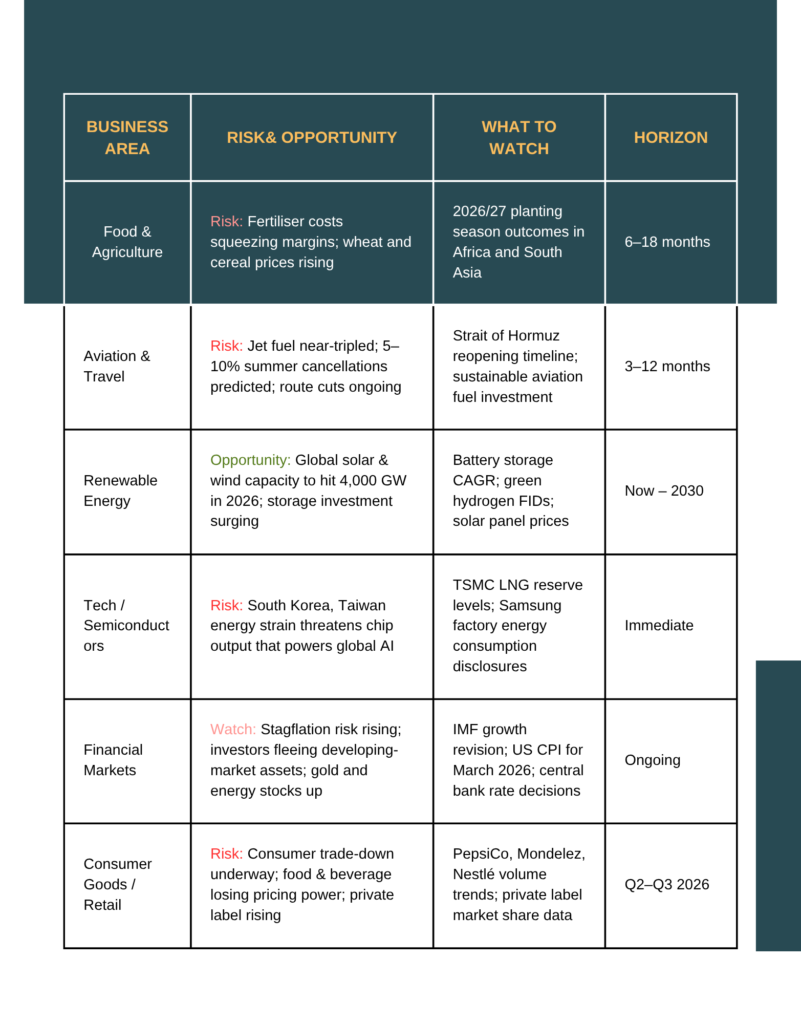
The 2026 energy crisis is not merely a disruption to energy markets. It is a comprehensive stress test of the global economy and it is revealing, with brutal clarity, which businesses, which countries, and which systems are fragile, and which are resilient. Here are the business predictions that matter.
Now → Mid-2026
The Immediate Shocks
- Stagflation risk rising: inflation up, growth down simultaneously.
- Food manufacturers losing pricing power as consumers trade down.
- Airlines absorbing $400M+ in additional fuel costs per major carrier.
- Energy-sector stocks up 33% – YTD, the only clear equity winner.
- Borrowing costs rising across Africa, Latin America, and developing Asia
- Semiconductor output at risk as South Korea and Taiwan face energy strain
Late 2026 → 2027
The Medium-Term Shift
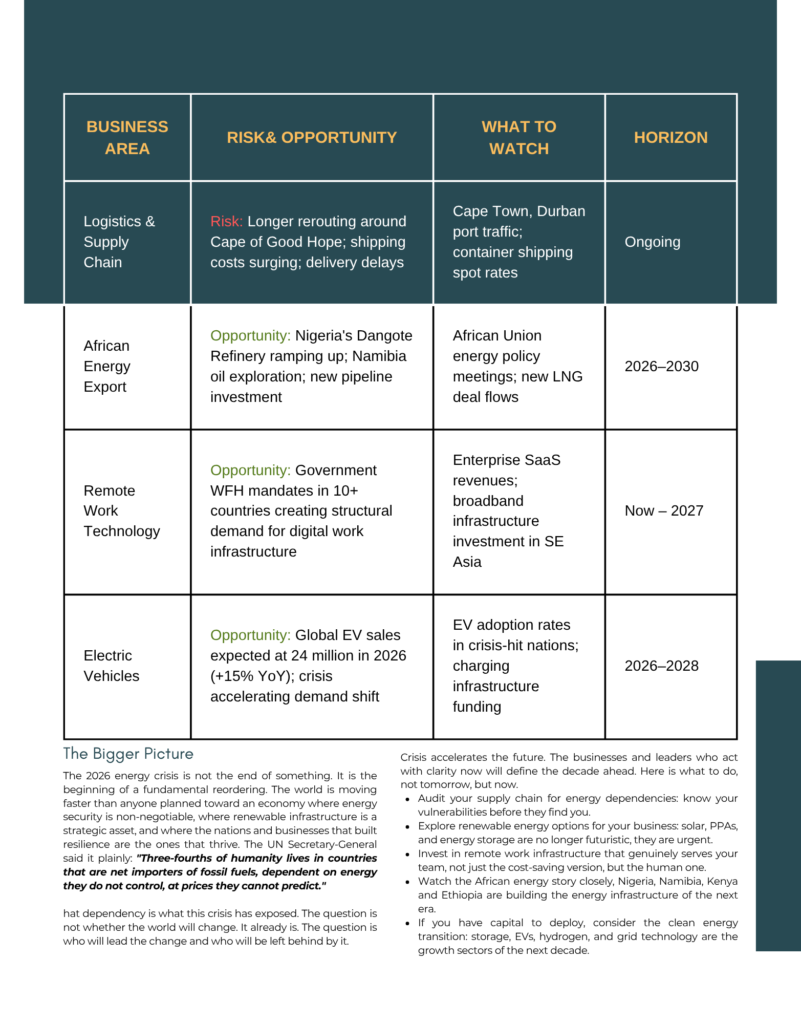
- Clean energy investment will accelerate, crisis is the best recruiter renewables ever had.
- Supply chains will be redesigned around energy security, not just cost.
- Countries with high renewables share (Spain, Norway, Kenya) gain competitive advantage.
- Energy storage becomes a top infrastructure priority globally.
- Fertiliser shortages feed into a second-wave food price spike in 2027.
- WFH infrastructure investment rises as governments formalise emergency learnings.
2028 and Beyond
The New World Order
- Energy sovereignty becomes a national security doctrine in every major economy.
- The power triad of Compute + Data + Energy dominates geopolitical competition.
- Countries with cheap, clean, reliable electricity will attract the AI economy.
- Africa’s energy exporters (Nigeria, Namibia) gain long-term strategic leverage.
- Next-generation nuclear (SMRs) and hydrogen move from pilot to commercial scale.
- The global investment benchmark shifts from ESG to ESR, Energy Security and Resilience.
- Morgan Stanley’s analysis is stark: large technology companies are expected to commit over $1 trillion in infrastructure spending in the 2025–2026 period alone. The World Economic Forum’s January 2026 assessment confirmed that “there is no AI at scale without energy intelligence.” The next generation of AI data centres will not be built where land is cheapest. They will be built where power is most available, most reliable, and most affordable. This single fact will reshape global investment flows for the next decade.