best casino sites for Canadians top real money casinos for Canadians safe online casinos for Canadian players Canadian online casino rankings best mobile casino Canada

Spotlighting Remarkable Women and Girls

Unseen, Not Unworthy: The Quiet Power of Women in the Workplace

By Francisca Sinjae

There’s a curious thing that happens when a woman walks into a meeting and drops a golden idea on the table: it sparkles for a moment, then a colleague with a deeper voice repackages it five minutes later, and suddenly, it’s brilliant. Everyone nods, writes it down, and she sits back wondering, Was I invisible, or just wearing the wrong vocal tone?

Cue “the Matilda Effect”, the academic name for this maddening magic trick where women’s genius becomes invisible and men’s “insight” shines with borrowed light. It’s not new. In fact, history is stacked with stories of women who launched revolutions in science, art, and literature, e.t.c while someone else walked away with the glory (and the paycheck).

So let’s open the vault, dust off the receipts, and shine a spotlight on the women whose ideas changed the world, even if the world forgot to say thank you.

  1. Rosalind Franklin: The Woman Who Photographed Life

Let’s take a trip to time and travel to 1952, British chemist Rosalind Franklin is hunched over a powerful X-ray machine, snapping high-resolution images of DNA molecules. One of them, known as Photo 51, captures the famous double-helix structure.

What happens next? Her male colleague quietly shares that photo with Watson and Crick, who build on it (without telling her) and rush to publish a paper. In 1962, they receive the Nobel Prize. Rosalind? She’s not mentioned, not even in the footnotes. She had died four years earlier, unaware she had handed over the blueprint for life itself.

Science owes her everything. And while she may not have received the medal, her legacy is now etched into biology’s DNA.

2. Gabrielle Colette: The Ghostwriter of Her Own Bestsellers

Imagine writing a bestselling novel, only to have your husband slap his name on it and rake in the fame. That’s the origin story of Gabrielle Colette, who penned a series of wildly popular novels in early 1900s Paris, including Claudine and Gigi. Her husband, Willy, published them under his name while Colette wrote furiously in secret.

Eventually, she said “non, merci” to ghostwriting and divorced him. Her real name finally graced the covers, and today, she’s celebrated as one of France’s greatest literary voices. Moral of this story? Even if your name isn’t on the title page yet, your words will outlive the impostors.

3. Ada Lovelace: The First Ever Computer Programmer in the 1800s!

Long before TikTok, texting, or turning things off and back on again, Ada Lovelace looked at a mechanical machine and thought, “Hmm… this thing could do more than just math. It could follow instructions. It could… compute.”

In 1843, she wrote what is now recognized as the first computer program, decades before modern computers existed. Charles Babbage designed the engine, but Ada imagined the future.

For over a century, tech bros got the credit. Only recently has Ada risen from the techie shadows to take her rightful place as the original coder queen.

4. Margaret Keane: Painting in Plain Sight, Signing in Disguise

In the swinging 1960s, those wide-eyed child paintings were everywhere, on postcards, gallery walls, even in homes of Hollywood royalty. Everyone knew the artist: Walter Keane.

Except… he didn’t paint a single one. His wife, Margaret Keane, did, in silence, behind closed doors, afraid no one would believe a woman could be that successful. In 1986, she finally sued him. The judge asked both to paint in court. Walter refused. Margaret painted. She won.

Today, she’s recognized as the true artist of the “Big Eyes” legacy. Her story is part courtroom drama, part comeback tale, and 100% proof that talent doesn’t stay hidden forever.

5. Lise Meitner: The Woman Who Unlocked the Atom, and Got Erased

If splitting the atom were a Hollywood film, Lise Meitner would be the lead scientist, the hidden brain, and the heroine who refused to build bombs.

In the late 1930s, while exiled from Nazi Germany, Lise helped interpret groundbreaking findings that proved nuclear fission was possible. Her male lab partner, Otto Hahn, used her calculations, and won the 1944 Nobel Prize alone.

Lise was left out. Again.

Still, she kept working, refused to participate in weapon development, and lived long enough to see the world finally whisper what it should have shouted: She was the true architect of nuclear physics.

6. Jocelyn Bell Burnell: The Stargazer Who Discovered Pulsars

In 1967, 24-year-old astrophysics student Jocelyn Bell Burnell noticed something odd: a pulsing radio signal coming from space. Her supervisor dismissed it. She didn’t.

Her persistence led to the discovery of pulsars, rotating neutron stars that blink like cosmic lighthouses. It was one of the biggest astrophysical breakthroughs of the 20th century.

Guess who got the Nobel Prize in 1974? Not Jocelyn. Her male supervisor did.

Did she rage? Nope. She smiled, kept working, and later donated her $3 million physics award to help women and minorities in science.

Because that’s what quiet power looks like.

What’s the Lesson Here?

The Matilda Effect isn’t just dusty history, it’s daily reality. It’s every time you present the strategy and someone else gets the spotlight. It’s when your “helping out” becomes someone else’s “great leadership.”

But here’s the thing: power doesn’t have to be loud to be real. You don’t need to shout to be brilliant. You just need to know the value of your voice, and use it, even when others don’t echo it right away.

So document your wins. Speak your name. Back up another woman in the room. And remember:

Being unseen doesn’t make you unworthy, it just makes your glow a little more patient.

Because when history finally looks back, it doesn’t always remember who shouted the loudest, it remembers who changed the game and That right there is success “What you attract by who you become”.


Share:

Trending

Raising Women Magazine Issue 045 – June 2026

There is a difference between living and merely functioning.
Somewhere between the notifications, deadlines, responsibilities, ambitions, and endless demands of modern life, many of us have become exceptionally good at keeping going. We show up. We deliver. We carry. We cope. Yet beneath the appearance of productivity, an important question remains: are we truly well?
In this issue of Raising Women Magazine, we explore wellness not as a trend, but as a deeper conversation about humanity, health, purpose, and presence.
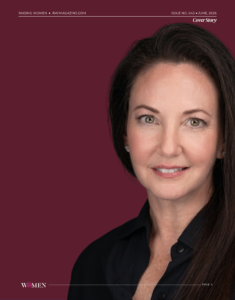
Our cover feature introduces Dr. Heidi Beilis, a pioneering physician helping to shape the future of healthcare through artificial intelligence. Her work reminds us that innovation is at its best when it serves people, particularly women whose lives may be transformed by earlier diagnoses and better outcomes.
Elsewhere, we explore grief, ambition, beauty, leadership, healthspan, rest, and the invisible burdens many women carry. We ask difficult questions about what it means to thrive, not simply survive.
As I wrote in this issue’s Find Her Light column, sometimes the rest we need is not sleep. Sometimes it is space. Sometimes it is perspective. Sometimes it is permission.
May these pages offer all three.

Raising Women Magazine Issue 044 – May 2026

There is something deeply revealing about the way a society treats its children. Not just in policy or parenting, but in the stories it tells them, the spaces it creates for them, and the kind of world it quietly prepares them to inherit. In this Children’s Day edition, Raising Women Magazine turns its attention to childhood itself, not as a sentimental phase of life, but as the foundation upon which identity, confidence, memory, and humanity are built.

Our cover star, Ms. Rachel, represents a refreshing reminder that gentleness still matters in an age of noise. Through patience, intentionality, and emotional safety, she has transformed songs and screen time into a global classroom for millions of children and families.

Across this issue, we explore the emotional architecture of childhood, from the girls who learn too early to shrink themselves, to the children quietly carrying adult burdens before they fully understand their own. We also interrogate modern parenting, digital culture, family, safety, and the futures young people are already shaping.

Because childhood is never just preparation for life.

In many ways, it is life itself.

The Family Tree Divide

What Women Are Given, and What They Build By Sipho Khumalo Two women walk into the same room. One is recognised before she speaks. The

Your guide to IVF and egg freezing in Korea

Empowering your family planning journey with curated fertility treatments at lower costs. Get our guide for Korea’s leading clinics, pricing and service breakdown.

Recommended News

Raising Women Magazine Issue 045 – June 2026

There is a difference between living and merely functioning.
Somewhere between the notifications, deadlines, responsibilities, ambitions, and endless demands of modern life, many of us have become exceptionally good at keeping going. We show up. We deliver. We carry. We cope. Yet beneath the appearance of productivity, an important question remains: are we truly well?
In this issue of Raising Women Magazine, we explore wellness not as a trend, but as a deeper conversation about humanity, health, purpose, and presence.
Our cover feature introduces Dr. Heidi Beilis, a pioneering physician helping to shape the future of healthcare through artificial intelligence. Her work reminds us that innovation is at its best when it serves people, particularly women whose lives may be transformed by earlier diagnoses and better outcomes.
Elsewhere, we explore grief, ambition, beauty, leadership, healthspan, rest, and the invisible burdens many women carry. We ask difficult questions about what it means to thrive, not simply survive.
As I wrote in this issue’s Find Her Light column, sometimes the rest we need is not sleep. Sometimes it is space. Sometimes it is perspective. Sometimes it is permission.
May these pages offer all three.

Raising Women Magazine Issue 044 – May 2026

There is something deeply revealing about the way a society treats its children. Not just in policy or parenting, but in the stories it tells them, the spaces it creates for them, and the kind of world it quietly prepares them to inherit. In this Children’s Day edition, Raising Women Magazine turns its attention to childhood itself, not as a sentimental phase of life, but as the foundation upon which identity, confidence, memory, and humanity are built.

Our cover star, Ms. Rachel, represents a refreshing reminder that gentleness still matters in an age of noise. Through patience, intentionality, and emotional safety, she has transformed songs and screen time into a global classroom for millions of children and families.

Across this issue, we explore the emotional architecture of childhood, from the girls who learn too early to shrink themselves, to the children quietly carrying adult burdens before they fully understand their own. We also interrogate modern parenting, digital culture, family, safety, and the futures young people are already shaping.

Because childhood is never just preparation for life.

In many ways, it is life itself.

The Family Tree Divide

What Women Are Given, and What They Build By Sipho Khumalo Two women walk into the same room. One is

First, Believe

By The Lulu They said the sky’s the limit But what if you’re still underground, still digging through the dirt

RudolphCasinos