Spotlighting Remarkable Women and Girls

Women-Led Groups Receive Less Than 1% of Humanitarian Aid, Despite Being the Lifeline in Crisis

By Tilly Boateng

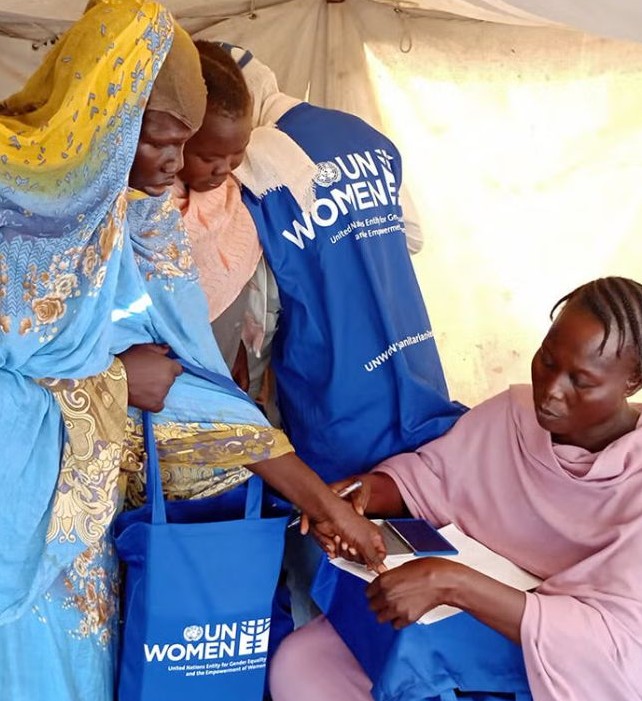
When disaster strikes, women’s organizations are often the first to respond. They offer shelter, health services, protection and hope. Yet today, women-led organizations (WLOs) receive less than 1% of humanitarian aid globally, jeopardizing their ability to support communities in crisis zones.

The Hidden Heroism of Women on the Ground

Across conflict areas, women’s organizations are delivering essential services. In Lebanon, for example, UN Women found that 47 out of 50 surveyed WLOs were deeply involved in relief efforts. These groups provided life-saving assistance, including food (40%), emergency education (40%), hygiene kits, and shelter, while reaching vulnerable populations like refugees (60%) and people with disabilities (40%).

But despite being on the frontlines and deeply embedded in their communities, only 8% of the humanitarian response funding in Lebanon went to women-led organizations.

When Funding Isn’t a Lifeline but a Lifeline Denied

UN Women’s global report underscores the gravity of the shortfall. Between 2021 and 2022, WLOs and women’s rights organizations received less than 1% (about US$142 million) of total humanitarian aid. As a result, 62% of those organizations had to reduce services, interrupting vital support like healthcare, economic aid, and protection from gender-based violence. Alarmingly, 67% scaled back support for GBV services, leaving survivors even more vulnerable.

Imagine the cost: over 500 women and girls die each day in crises from preventable pregnancy and childbirth complications due to unsafe or inaccessible care. With WLOs struggling, these figures are a stark reminder of the human impact at stake.

Gender-Based Violence: A Shockingly Underfunded Priority

While crises escalate the risk of gender-based violence (GBV), some estimates say 70% of women in conflicts experience it, global humanitarian spending on GBV remains under 1% of total aid. This low level of investment is catastrophic when protection should be a top priority.

A Global Snapshot and Growing Stakes

The picture is clear: crises are increasing, climate shocks, wars, displacement, but the support for women-led coordination and care is alarmingly low. About 614 million women and girls live in conflict zones today; they are nearly eight times more likely to be food insecure than men in the same regions.

Still, less than 1% of official development assistance is directed toward women’s rights initiatives in humanitarian contexts, a gap that undermines equitable recovery and resilience.

When Funding Disappears, Crisis Deepens

In Ukraine, the impact of funding cuts became immediate and harrowing. A recent survey found that 72% of women’s rights organizations were severely disrupted, and numerous groups risked total closure without new funds. Shockingly, less than 1% of ODA to Ukraine specifically targeted gender equity, despite the acute need.

Change Is Possible: Investing in Feminist Humanitarianism Pays Off

Amid these gaps, there’s hope in initiatives grounded in feminist aid principles. The UN Trust Fund to End Violence Against Women reached over 14.7 million people through 180 women-led organizations in 74 countries, but its budget remains small compared to global need.

Similarly, the Women, Peace, and Humanitarian Fund (WPHF) supported 579 local WLOs across 34 crisis-hit countries, showing what is possible when funding is flexible, direct, and feminist-led.

Why is this important?

  • Effectiveness over bureaucracy: WLOs act fast, understand local needs, and sustain community trust.
  • Equity in action: When organizations led by women receive funding, they ensure women and girls receive protection, healthcare, and leadership.
  • Sustainable impact: Feminist funding models, long-term, flexible, local-first, build real resilience, healing ripple effects through entire communities.

A Call to Fund Feminist Aid

If global aid systems are serious about inclusion, resilience, and impact, they must pivot investment toward women-led and rights-based organizations, not thin crumbs, but real partnership. Without this shift, we risk sidelining hope where people need it most.
Share:

Trending

Raising Women Magazine Issue 046 – June 2026

There is something deeply revealing about the way a society treats its children. Not just in policy or parenting, but in the stories it tells them, the spaces it creates for them, and the kind of world it quietly prepares them to inherit. In this Children’s Day edition, Raising Women Magazine turns its attention to childhood itself, not as a sentimental phase of life, but as the foundation upon which identity, confidence, memory, and humanity are built.

Our cover star, Ms. Rachel, represents a refreshing reminder that gentleness still matters in an age of noise. Through patience, intentionality, and emotional safety, she has transformed songs and screen time into a global classroom for millions of children and families.

Across this issue, we explore the emotional architecture of childhood, from the girls who learn too early to shrink themselves, to the children quietly carrying adult burdens before they fully understand their own. We also interrogate modern parenting, digital culture, family, safety, and the futures young people are already shaping.

Because childhood is never just preparation for life.

In many ways, it is life itself.

Raising Women Magazine Issue 045 – June 2026

There is a difference between living and merely functioning.
Somewhere between the notifications, deadlines, responsibilities, ambitions, and endless demands of modern life, many of us have become exceptionally good at keeping going. We show up. We deliver. We carry. We cope. Yet beneath the appearance of productivity, an important question remains: are we truly well?
In this issue of Raising Women Magazine, we explore wellness not as a trend, but as a deeper conversation about humanity, health, purpose, and presence.
Our cover feature introduces Dr. Heidi Beilis, a pioneering physician helping to shape the future of healthcare through artificial intelligence. Her work reminds us that innovation is at its best when it serves people, particularly women whose lives may be transformed by earlier diagnoses and better outcomes.
Elsewhere, we explore grief, ambition, beauty, leadership, healthspan, rest, and the invisible burdens many women carry. We ask difficult questions about what it means to thrive, not simply survive.
As I wrote in this issue’s Find Her Light column, sometimes the rest we need is not sleep. Sometimes it is space. Sometimes it is perspective. Sometimes it is permission.
May these pages offer all three.

Up Coming Events

by Oluchi Obiahu MEET AFRICA FASHION FESTIVAL (MAFEST) 2026 Date: Monday, May 25, 2026 Location: Abuja, Nigeria Get ready for one of the most creative

Your guide to IVF and egg freezing in Korea

Empowering your family planning journey with curated fertility treatments at lower costs. Get our guide for Korea’s leading clinics, pricing and service breakdown.

Recommended News

Raising Women Magazine Issue 046 – June 2026

There is something deeply revealing about the way a society treats its children. Not just in policy or parenting, but in the stories it tells them, the spaces it creates for them, and the kind of world it quietly prepares them to inherit. In this Children’s Day edition, Raising Women Magazine turns its attention to childhood itself, not as a sentimental phase of life, but as the foundation upon which identity, confidence, memory, and humanity are built.

Our cover star, Ms. Rachel, represents a refreshing reminder that gentleness still matters in an age of noise. Through patience, intentionality, and emotional safety, she has transformed songs and screen time into a global classroom for millions of children and families.

Across this issue, we explore the emotional architecture of childhood, from the girls who learn too early to shrink themselves, to the children quietly carrying adult burdens before they fully understand their own. We also interrogate modern parenting, digital culture, family, safety, and the futures young people are already shaping.

Because childhood is never just preparation for life.

In many ways, it is life itself.

Raising Women Magazine Issue 045 – June 2026

There is a difference between living and merely functioning.
Somewhere between the notifications, deadlines, responsibilities, ambitions, and endless demands of modern life, many of us have become exceptionally good at keeping going. We show up. We deliver. We carry. We cope. Yet beneath the appearance of productivity, an important question remains: are we truly well?
In this issue of Raising Women Magazine, we explore wellness not as a trend, but as a deeper conversation about humanity, health, purpose, and presence.
Our cover feature introduces Dr. Heidi Beilis, a pioneering physician helping to shape the future of healthcare through artificial intelligence. Her work reminds us that innovation is at its best when it serves people, particularly women whose lives may be transformed by earlier diagnoses and better outcomes.
Elsewhere, we explore grief, ambition, beauty, leadership, healthspan, rest, and the invisible burdens many women carry. We ask difficult questions about what it means to thrive, not simply survive.
As I wrote in this issue’s Find Her Light column, sometimes the rest we need is not sleep. Sometimes it is space. Sometimes it is perspective. Sometimes it is permission.
May these pages offer all three.

Up Coming Events

by Oluchi Obiahu MEET AFRICA FASHION FESTIVAL (MAFEST) 2026 Date: Monday, May 25, 2026 Location: Abuja, Nigeria Get ready for

Past Events

By Oluchi Obiahu CANNES FILM FESTIVAL 2026 Dates: May 12 – 23, 2026 For twelve sun-drenched days on the French

POETRY

by The Lulu I miss my childhood. I miss the version of me that laughed from the stomach, that ran