By Francisca Sinjae
There’s something electric about the log drum. That hypnotic, rubbery bass that sneaks up on you, pulls your shoulders into a bounce, and reminds you, “This is amapiano.” Originating from the townships of South Africa in the mid-2010s, the genre’s DNA is deeply rooted in house, kwaito, jazz, and lounge music. But make no mistake: this isn’t just a sound, it’s a cultural revolution. And in the middle of this revolution, women are not just dancing to the beat. They’re making it. Literally.
For the longest time, amapiano was a boys’ club. The music, the DJ booths, the studio sessions, dominated by men, with women often relegated to vocal features or video appearances. But the script is flipping fast, and the women of amapiano are grabbing the AUX cord, twisting the knobs, and injecting new life into the genre. They’re not just contributing they’re redefining.
Let’s talk about Uncle Waffles, yes, a woman, not your uncle. Lungelihle Zwane, the Swazi born DJ and producer who exploded onto the scene in 2021, is arguably the most viral amapiano act in recent memory. Her Boiler Room set in Johannesburg was pure sorcery, choreographed energy, seamless mixes, and a wild crowd that knew every beat drop before it happened. But beyond the viral clips and the co-signs from global stars like Drake, Uncle Waffles is a symbol of what’s possible when women claim the decks. She produces, she DJs, she performs, and she does it all while rocking her signature crop tops and braids, never compromising her femininity to fit in.
Then there’s TxC, a powerful DJ duo made up of Tarryn Reid and Clairise Hefke. These two South African women are not just spinning tracks; they’re shaping the culture. Known for their deep cuts and genre blending sets that swing from soulful to hard hitting, TxC is touring Europe and Africa, proving that amapiano is not just local, it’s global. And they’re bringing their own production style into play, collaborating with a mix of producers and musicians, making sure the feminine touch isn’t just heard but felt.
What makes this rise of women in amapiano so significant isn’t just the visibility. It’s the sound itself. There’s a noticeable shift in tone, structure, and experimentation. Tracks led by women often have a richer emotional spectrum think lush harmonies, layered vocals, and intentional storytelling. It’s not just about turning up; it’s about tapping in. One example is DBN Gogo, another heavyweight who defies every stereotype thrown her way. Born Mandisa Radebe, DBN Gogo didn’t grow up dreaming of being behind turntables, yet today she’s one of the most booked amapiano DJs across Africa. Her sets are unpredictable, complex, and spiritually alive. And she’s not just spinning beats, she’s also producing them.
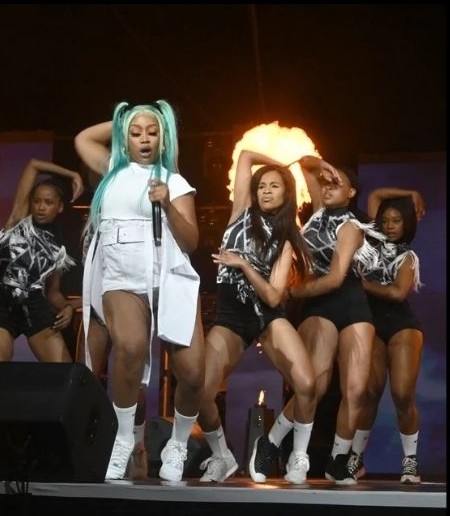
Now, amapiano is a genre that thrives on collaboration. The magic often happens in makeshift studios, shared files, voice notes turned into hooks. And women producers are claiming these collaborative spaces in a way that’s never happened before. Kamo Mphela, often called the “Queen of Amapiano,” started as a dancer, but she’s since evolved into a full blown performer and creative director of her own sound. In a space where dancers and vocalists were once disposable, Kamo said, “No, I’ll do it all.” She’s directing her music videos, working on her own tracks, and building a multi-platform brand that’s every bit as powerful as her male counterparts.
This is amapiano feminism. It’s not the textbook version. It’s loud. It’s sensual. Its groove filled, sometimes messy, always electric. It’s about women building their own lanes in an industry that once refused to make room. And they’re doing it with flair, with nails done and beats knocking.
We can’t ignore how platforms have played a role in this evolution. Social media, particularly TikTok, has become unknown track into a global hit. And women are using this power to break themselves, their friends, and even total strangers into the limelight. It’s grassroots. It’s sisterhood. It’s the algorithm doing what the industry gatekeepers never did a major amplifier for women in amapiano.
But let’s get real, this visibility doesn’t mean the battle’s over. Many women producers still fight for respect in the studio. They’re questioned more, underestimated more, and often sidelined during the credit roll. The solution? Some are choosing to build their own production houses.
Lelowhatsgood, a queer DJ and event curator, has been instrumental in organizing safe spaces for women and LGBTQ+ creatives within the amapiano scene.
Events like ‘Pussy Party’ and ‘Fruitcake’ are not just parties, they’re political, creative sanctuaries where women producers can test new sounds without judgement.
And it’s working. The sonic diversity of amapiano is expanding, and more women are showing up not just in the booth, but in sound design, mastering, and mixing. These aren’t just technical roles they’re critical to shaping how the music feels. In many cases, the soft glide between melody and beat, the goosebumps moment is crafted by women with a deep, intuitive connection to emotion and rhythm.
Globally, the world is watching. Women amapiano artists are headlining in Berlin, London, Lagos, and Nairobi. Nigerian DJ Tania Omotayo is jumping into the sound. Ghanaian and Kenyan female producers are blending amapiano with afrobeats and benga. The ripple effect is continental. Soon, it’ll be cosmic.
So what does the future look like for women in amapiano? Honestly, it looks like more of them. More mentorship. More all-female lineups. More behind-the-scenes credits. More gear in their hands. More freedom to be soft, or fierce, or both.
Amapiano feminism isn’t about kicking men out of the booth, it’s about saying, “We’ve got headphones too.” And when women put them on, the bass hits different.
From the bedroom studio to the global festival stage, women in amapiano are proving that feminism can dance, and produce the beat too.