By Dr May Ikeora-Amamgbo & Sipho Khumalo
There is a rhythm to March that we have come to recognise. It begins with intention. It builds into celebration. It crescendos into visibility. Rooms fill. Stages are set. Women speak, boldly, brilliantly, unapologetically. We are told to own our voices, claim our space, rewrite our narratives. And for a moment, it feels as though the world has tilted, just slightly, in our favour. It is powerful. It is necessary. It is deserved. But when the rooms empty and the applause dissolves into memory, a question remains. Not loud enough to trend, but strong enough to stay. What are we building?
Not what we are saying. Not what we are posting. Not even what we are becoming in public. What are we building that will still stand when the language of empowerment evolves, as it inevitably will?
Long before empowerment became a movement, before it found its way into brand strategies and conference themes, there were women working quietly, persistently, often invisibly, building ideas,
systems, discoveries, and stories that would go on to shape the world. They were not waiting to be included. They were too occupied with the work. And in many cases, the world only caught
up later.
The Nobel Prize, perhaps one of the most uncompromising recognitions of human achievement, does not reward presence. It
rewards consequence. It asks a simple but unforgiving question, did this work change the world? And when we look at the women who have answered that question with their lives, we are forced to
confront a different standard of impact altogether.
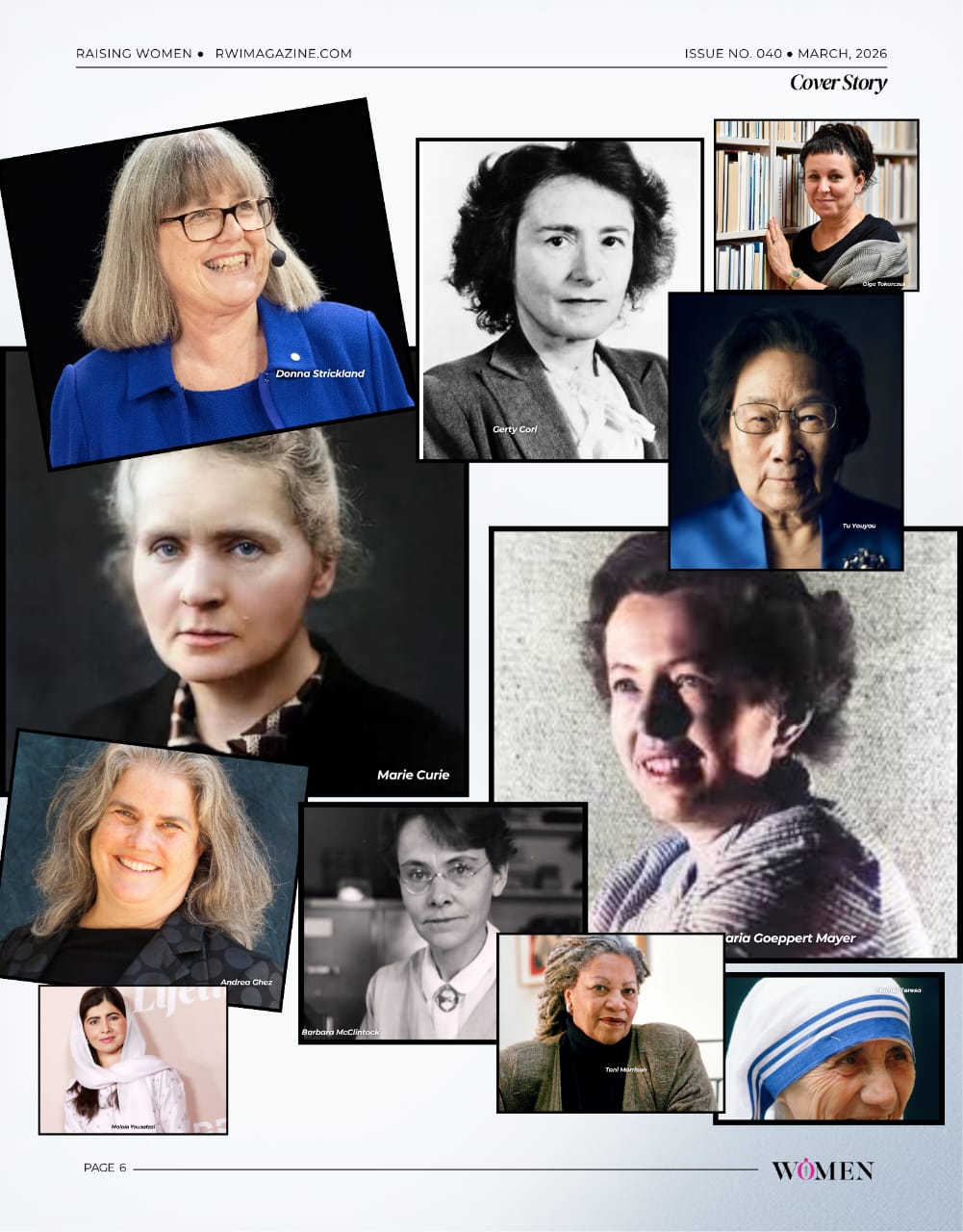
It is precisely this standard that informs this cover feature. At Raising Women Magazine, we are not only interested in the language of empowerment, we are invested in its substance especially as we come to the end of “women’s month” this March. In this feature, we turn our attention to women whose work has moved beyond visibility into permanence, across science, medicine, literature, peace, and economics, not as distant figures to admire, but as a mirror to examine our own ambition. This is not a celebration of titles, but an interrogation of impact. And as you read, the question is not simply what they built, but what you, in your own field, in your own way, are choosing to build that will endure.
Marie Curie: The Architecture of Discovery
To understand the magnitude of what it means to build something that endures, one must begin with Marie Curie, not simply because she was the first woman to receive a Nobel Prize, but because she redefined what scientific discovery could look like in both method and meaning.
Born in Warsaw in 1867, Curie’s early life was shaped by structural limitations that denied women access to formal higher education in her home country. Her relocation to Paris was not merely geographical but intellectual, allowing her entry into institutions that, while still resistant, could no longer entirely exclude her. At the Sorbonne, she immersed herself in physics and mathematics with a level of focus that would later define her career.
Her work on radioactivity, a term she introduced, did not simply add to existing knowledge but disrupted it. At a time when atoms were thought to be indivisible and stable, Curie demonstrated that they were capable of spontaneous energy emission, a revelation that fundamentally altered scientific understanding of matter.
Her subsequent discoveries of polonium and radium extended this work, opening pathways into nuclear physics, chemistry, and medical science.
It is perhaps tempting to frame Curie’s achievements in terms of “firsts,” the first woman to win a Nobel Prize, the first person to win two in different disciplines, but to do so risks diminishing the scale of her contribution. Her work laid the groundwork for radiation therapy, a treatment that has since become central to cancer care, saving millions of lives across generations. During the First World War, she extended her scientific expertise into practical application, developing mobile radiography units that brought diagnostic capabilities directly to the battlefield.
Curie did not operate within the expectation of recognition. She operated within the necessity of inquiry. What she built was not simply knowledge, but infrastructure for future discovery.
Physics and the Expanding Universe of Possibility
The intellectual lineage that follows Curie is marked by women who entered fields that had not yet learned how to accommodate them, and who proceeded to reshape those fields nonetheless.
Maria Goeppert Mayer’s journey offers a particularly instructive example of persistence within structural limitation. Despite her exceptional intellectual capacity, she spent years working in unpaid or adjunct positions due to institutional policies that restricted opportunities for women in academia. Yet her development of the nuclear shell model provided one of the most significant theoretical frameworks in modern physics, explaining the arrangement and stability of protons and neutrons within atomic nuclei. Her work did not merely contribute to the field, it reoriented it.
Donna Strickland’s contribution, recognised decades later, reflects a different kind of impact, one that integrates seamlessly into the fabric of everyday life while remaining largely invisible to those who benefit from it. Her work on chirped pulse amplification revolutionised laser technology, enabling the generation of high intensity, ultra short laser pulses. This innovation underpins a range of applications, from corrective eye surgery to advanced manufacturing processes, demonstrating how scientific breakthroughs often operate quietly within systems that transform daily experience.
Andrea Ghez extended this trajectory beyond the boundaries of the Earth, dedicating decades to the study of the Milky Way’s centre. Through meticulous observation of stellar motion, she provided conclusive evidence of a supermassive
black hole, an invisible yet dominant force shaping the structure of our galaxy. Her work expanded not only scientific knowledge but the scale at which humanity understands its place within the universe.
Collectively, these women did not simply advance physics. They altered the questions physics could ask.
Medicine, Survival, and the Intimacy of Impact
If physics concerns itself with the structure of the universe, medicine brings that inquiry into the immediacy of human survival, where the stakes are measured not in theory but in lives.
Gerty Cori’s work on carbohydrate metabolism, specifically the Cori cycle, provided foundational insight into how the human body converts glycogen into glucose and back again. This discovery remains central to understanding metabolic processes and diseases such as diabetes, illustrating how fundamental research can underpin entire areas of medical practice.
Barbara McClintock’s discovery of transposable elements, often referred to as “jumping genes,” challenged prevailing assumptions about genetic stability. At a time when DNA was understood as fixed and predictable, her findings introduced the concept of a dynamic genome capable of rearrangement and adaptation. Initially met with skepticism, her work has since become integral to modern genetics, influencing fields ranging from evolutionary biology to cancer research.
Tu Youyou’s contribution represents a convergence of scientific rigor and cultural knowledge. Working in China during a period of limited global collaboration, she turned to traditional medical texts in her search for a treatment for malaria. The result was the discovery of artemisinin, a compound that has saved millions of lives, particularly in regions where malaria remains a leading cause of mortality. Her work demonstrates that innovation does not always emerge from abundance, but often from the ability to draw connections across knowledge systems.
In each of these cases, the impact is not abstract. It is lived. It is measured in extended life expectancy, reduced mortality, and the quiet, often unnoticed transformation of human health.
Literature and the Rewriting of Consciousness
While science alters what we know, literature reshapes how we understand. Selma Lagerlöf’s recognition as the first woman to receive the Nobel Prize in Literature marked a shift in the cultural valuation of storytelling, bringing folklore and national identity into a broader literary conversation. Her work expanded the possibilities of narrative, situating imagination as a legitimate and powerful form of expression.
Toni Morrison’s contribution, however, operates at a different level of intensity. Through her exploration of the psychological and historical legacy of slavery, she redefined how literature engages with memory, identity, and trauma. Her work does not simply tell stories, it interrogates them, forcing readers to confront histories that resist simplification. In doing so, she reshaped not only literary discourse but cultural consciousness itself.
Olga Tokarczuk’s experimental narratives further extend this transformation, challenging linear storytelling and inviting readers to engage with time, space, and perspective in new ways. Her work reflects a broader philosophical inquiry into the nature of human experience, demonstrating how literature can operate as both art and analysis.
These women did not simply write within existing frameworks. They redefined the frameworks themselves.
Peace, Justice, and the Courage to Intervene
The pursuit of peace introduces a different dimension of impact, one that operates within the complexities of conflict, inequality, and human vulnerability.
Mother Teresa’s humanitarian work was rooted in presence, in the consistent, daily act of caring for those who had been excluded from systems of support.
Through the Missionaries of Charity, she built an institution that extended this care globally, demonstrating how individual commitment can scale into collective impact.
Malala Yousafzai’s advocacy for girls’ education represents a different form of intervention, one that transforms personal experience into global movement. Her willingness to speak, despite direct threat to her life, reframed the conversation around education as not merely a social issue but a fundamental human right. Her work continues to influence policy, advocacy, and the global prioritisation of education for girls.
In both cases, the work required not only vision but courage, the willingness to act within environments that resist change.
Economics, Systems, and the Reimagining of Power
Elinor Ostrom’s contribution to economic thought challenges one of the field’s most entrenched assumptions, that shared resources are inevitably subject to overuse and collapse. Through extensive field research, she demonstrated that communities are capable of managing common resources sustainably through cooperation and locally developed governance systems.
Her work has profound implications for contemporary challenges, particularly in the context of climate change and environmental sustainability. By shifting the focus from top down control to community based management, she redefined how power and responsibility can be distributed within economic systems. Ostrom did not simply critique existing models. She offered an alternative.
From Visibility to Consequence
Across these diverse fields, a pattern emerges that is both instructive and, perhaps, uncomfortable in its clarity. These women were not primarily concerned with being seen. They were concerned with solving.
Their work was not designed for immediate recognition, nor was it structured around the aesthetics of success. It was often slow, frequently contested, and in many cases, initially unrecognised.
And yet, it endures.
In contrast, contemporary conversations about empowerment often place significant emphasis on visibility, on occupying space, on being acknowledged within systems that were not originally designed to include women. These are important developments, and they represent meaningful progress.
However, visibility without substance risks becoming self contained, a cycle of recognition that does not necessarily translate into lasting change. The Nobel women offer a different metric. They suggest that the true measure of empowerment lies not in how prominently one is positioned, but in what one produces, what one builds, what one leaves behind.
The Responsibility of This Generation
As Women’s Month draws to a close, the challenge is not to diminish the importance of celebration, but to extend it into responsibility. The question is no longer whether women can lead, innovate, or transform. That has been demonstrated, repeatedly, across disciplines and generations.
The question is whether we are willing to engage with the level of commitment that such transformation requires. Are we building knowledge that will shape future inquiry? Are we developing solutions that address structural challenges? Are we creating institutions that will outlast our individual presence? Or are we, perhaps inadvertently, allowing the performance of empowerment to replace its practice?
The women who have been recognised at the highest levels of global achievement did not operate under ideal conditions.
Many faced exclusion, limited resources, and sustained resistance. Their work was not always understood in its time, nor was it always celebrated. But they persisted. And in that persistence, they built.
What Will Remain
It is easy to be visible in a moment. It is far more demanding to be consequential across time. Long after the language of empowerment shifts, long after the current frameworks of recognition evolve, what will remain are the structures we have built, the ideas we have developed, and the systems we have changed.
The question, then, is not whether we are present in the conversation. It is whether the world will be different because we were here. Ultimately, history does not remember the loudest voices. It remembers the work. And so, as the final echoes of March settle into silence, perhaps this is the only question worth carrying forward.
Not who is watching.
Not who is applauding.
But what, in the deepest and most deliberate sense, we are building.