By Emmanuella Abraham
How women are redesigning power, one workspace at a time.
For a long time, the desk was treated as a purely functional object. A flat surface, a chair, a place to work. But that assumption has quietly shifted. Today, the desk is no longer neutral. It is expressive, intentional, and increasingly, a reflection of how women see their work and themselves.
The change is not aesthetic alone. It is structural. Research from organisations such as Harvard Business Review and McKinsey & Company has consistently shown that workspace design influences focus, decision-making, and overall productivity. Lighting, layout, and visual order are not secondary details. They shape how work is done.
As more women move into flexible and independent work structures, especially post-pandemic, the home workspace has become a site of control. It is one of the few environments where both function and identity can be designed without compromise. The result is a shift away from generic setups toward spaces that feel considered.
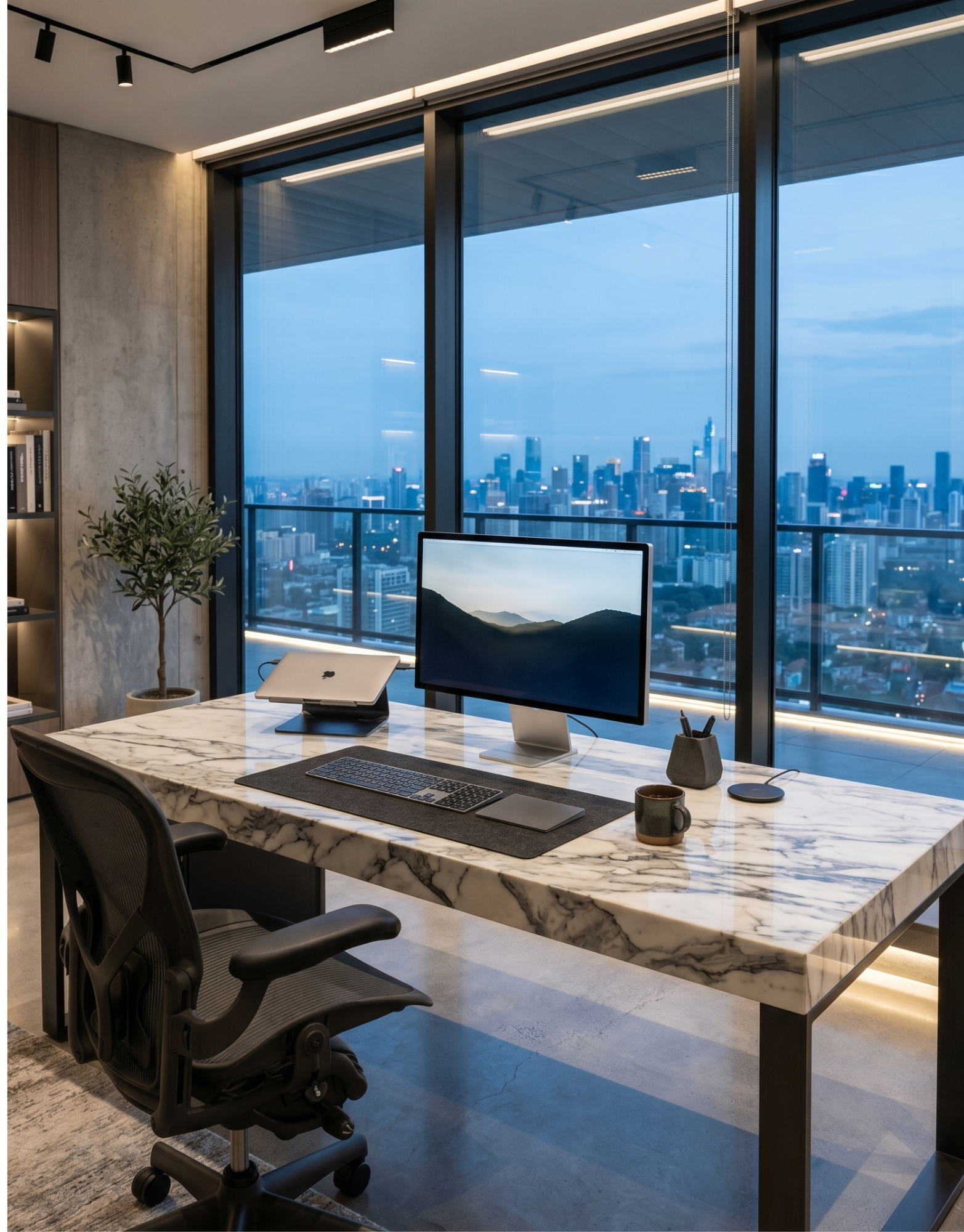
There is a pattern emerging. Desks are cleaner, but not empty. Objects are selected, not accumulated. A stack of books signals thought. A plant introduces softness. Materials matter. Wood, stone, glass. Each element contributes to an atmosphere that supports sustained attention without feeling clinical.
This attention to detail is not about perfection. It is about clarity. Visual clutter competes for cognitive space, and reducing it can improve focus. Studies in environmental psychology have linked organised workspaces to improved task completion and lower stress levels. The desk becomes less about decoration and more about removing friction from the work itself.
There is also a quiet assertion of ownership. Historically, workspaces, especially formal ones, have been designed with uniformity in mind. Personalisation was limited. Now, particularly in private or hybrid work settings, women are reclaiming that space. The desk becomes a place where aesthetics and authority can coexist.
Technology plays a role, but it is increasingly integrated rather than dominant. Laptops, tablets, and accessories are styled into the environment rather than defining it. The emphasis is on balance. Function remains central, but it is supported by an environment that feels stable and intentional.
What is most interesting is how subtle the shift appears from the outside. A well-placed lamp, a carefully chosen chair, a restrained colour palette. None of these are dramatic on their own. But together, they create a workspace that signals something different. Not just productivity, but presence.
The modern desk is no longer just where work happens. It is where decisions are shaped, where ideas are built, and where a certain kind of authority is quietly expressed.
The linked guide provides a neutral overview of licensed online casinos, pokies, bonuses and payment methods with information that can help Australian players compare service features and payment options. https://tosss.ca/best-online-casinos-ontario-community-guide/