By Francisca Sinjae
Across centuries, architecture has carried memory. Temples, shrines and ceremonial halls are more than buildings; they are repositories of belief, craftsmanship and cultural identity. Yet many of these structures exist only in fragments today, weathered by time or transformed by modern development.
Chinese artist Xiao Qi has found a remarkable way to bring these historical spaces back into the present.
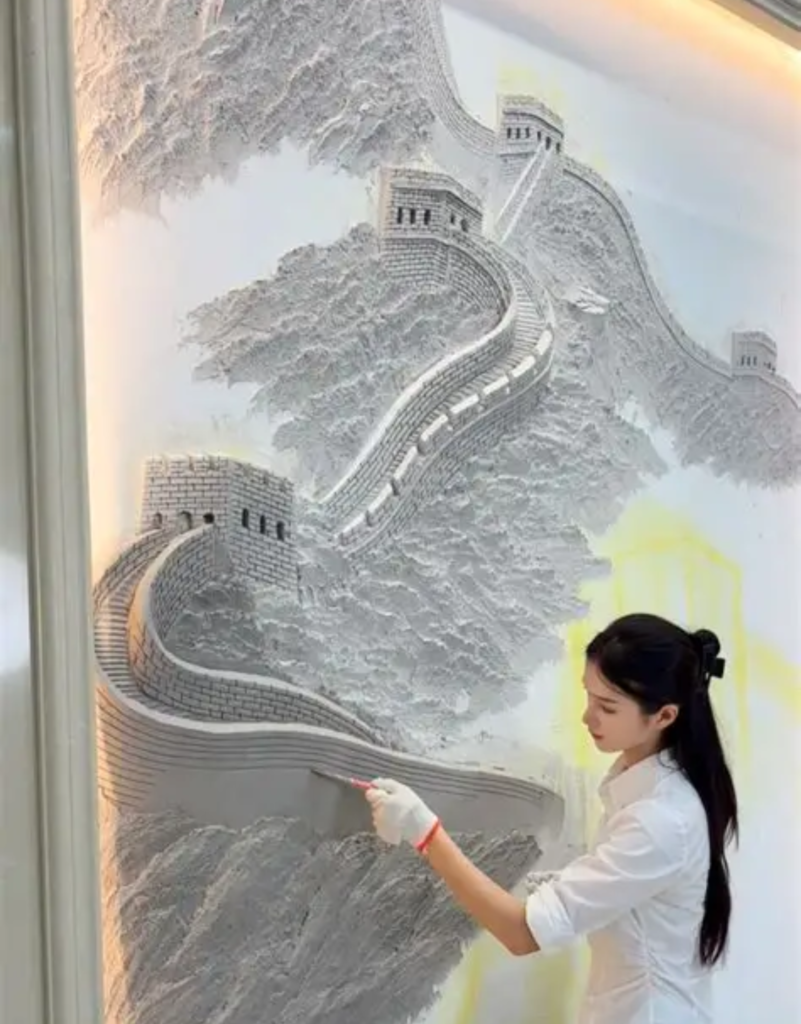
Through highly detailed relief murals, she reconstructs the grandeur of traditional Chinese temples, transforming flat surfaces into sculpted landscapes of columns, rooftops and courtyards.
Each work appears almost architectural in itself, as though a historic temple had been carefully lifted from the past and embedded within the wall.
Her art does not merely depict history. It rebuilds it in three dimensions.
A Wall That Becomes Architecture
Relief sculpture sits somewhere between painting and architecture. Unlike flat images, relief murals project outward from their surface, creating depth through carved or moulded layers.
In Xiao Qi’s work, that depth becomes the central language of storytelling.
Her murals portray temple complexes with extraordinary precision, layered roofs with curved eaves, towering pillars, ceremonial stairways and intricate wooden carvings. The structures seem to emerge gradually from the wall, as if the architecture itself is being rediscovered beneath the surface.
Light and shadow play across the carved forms, enhancing the illusion of movement and spatial depth.
Standing before one of her murals can feel almost like looking through a window into another era.
The Craft Behind the Illusion
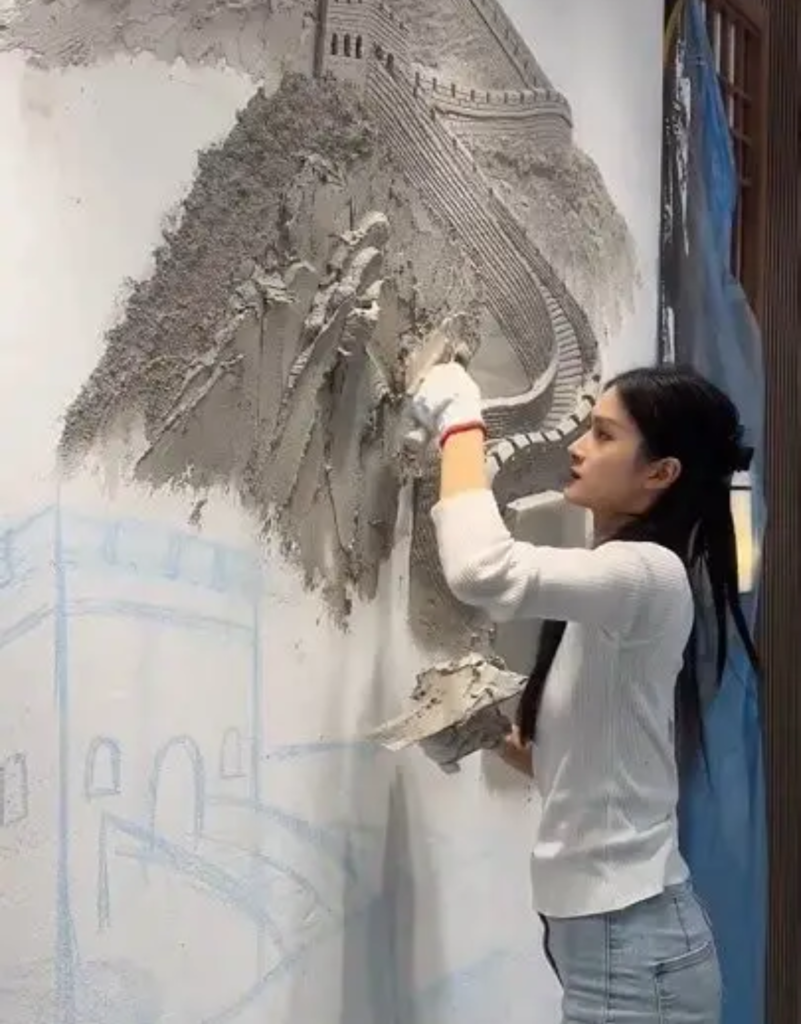
Creating such works requires patience, architectural knowledge and extraordinary technical discipline. Each mural begins with extensive study. Xiao Qi researches historical Chinese temple design, examining traditional layouts, roof structures and decorative motifs that have defined Chinese sacred architecture for centuries.
From there, she builds the composition layer by layer. The relief technique demands that every element be carefully planned. Foreground structures must project outward while distant features remain subtly recessed, producing the illusion of perspective.
The result is a visual experience that feels almost cinematic. Roofs rise above courtyards. Corridors appear to stretch into the distance. Carved beams and lanterns seem ready to sway in an invisible breeze. The temples she recreates feel alive.
Architecture as Cultural Memory
China’s temple architecture carries profound cultural meaning. From Buddhist monasteries to Daoist sanctuaries and ancestral halls, these structures reflect centuries of spiritual philosophy, craftsmanship and aesthetic tradition.
Their design follows principles rooted in symmetry, harmony and balance, often aligned with classical concepts of cosmic order. Yet many historic temples have been altered, damaged or lost through time.
Artists like Xiao Qi play a quiet but important role in preserving the visual memory of these spaces. By recreating temple architecture through sculpture, she allows audiences to experience the grandeur of these structures in a new way.
Her murals function almost like cultural archives, capturing details of architectural heritage that might otherwise fade from collective memory.
When Art Becomes a Portal
One of the most striking aspects of Xiao Qi’s work is the sense of movement it creates.
Although carved from solid material, the scenes feel dynamic. Courtyards appear open to the sky. Staircases invite the viewer to step forward. Layered rooftops create a rhythm of rising forms that guides the eye across the mural.
This sense of motion transforms the wall itself. What might have been a static surface becomes an immersive landscape.
Viewers often describe the experience of standing before her murals as similar to entering an architectural space rather than observing a sculpture.
In this way, Xiao Qi’s work blurs the boundary between art, architecture and history.
The Power of Detail
Much of the emotional impact of Xiao Qi’s murals lies in the extraordinary attention to detail.
Every tile on a temple roof, every carved dragon motif and every pillar base is rendered with meticulous care. These small elements build the overall sense of realism that defines her work.
Yet the goal is not simply accuracy. It is atmosphere.
Through depth and shadow, the murals evoke the quiet reverence associated with sacred spaces. Even without human figures present, the temples feel inhabited by centuries of ritual and movement.
The viewer becomes aware of time itself embedded within the architecture.
Reviving Tradition Through Contemporary Art
While Xiao Qi’s work draws heavily from traditional architectural forms, her approach is distinctly contemporary.
Relief murals have existed for thousands of years, appearing in ancient civilisations from Egypt to Greece and China itself. Yet by focusing specifically on historical temple architecture, Xiao Qi has adapted the medium into a unique modern practice.
Her sculptures function both as artworks and historical interpretations.
They remind audiences that cultural heritage is not static. It continues to evolve through the artists who reinterpret it.
In this sense, Xiao Qi’s murals extend the legacy of the temples they depict.
They ensure that the beauty and craftsmanship of traditional architecture remain visible in modern artistic conversation.
A Dialogue Between Past and Present
Art often serves as a bridge between generations.
Through her relief murals, Xiao Qi creates a dialogue between ancient architecture and contemporary viewers. The temples she reconstructs belong to centuries past, yet the experience of encountering them through sculpture feels immediate and alive.
Her work invites us to slow down and observe the intricate craftsmanship that defined historical architecture.
It reminds us that buildings are not merely functional spaces, they are expressions of cultural imagination.
And sometimes, through the hands of a skilled artist, even the oldest temples can rise again from the surface of a wall.