By Daniel Agusi
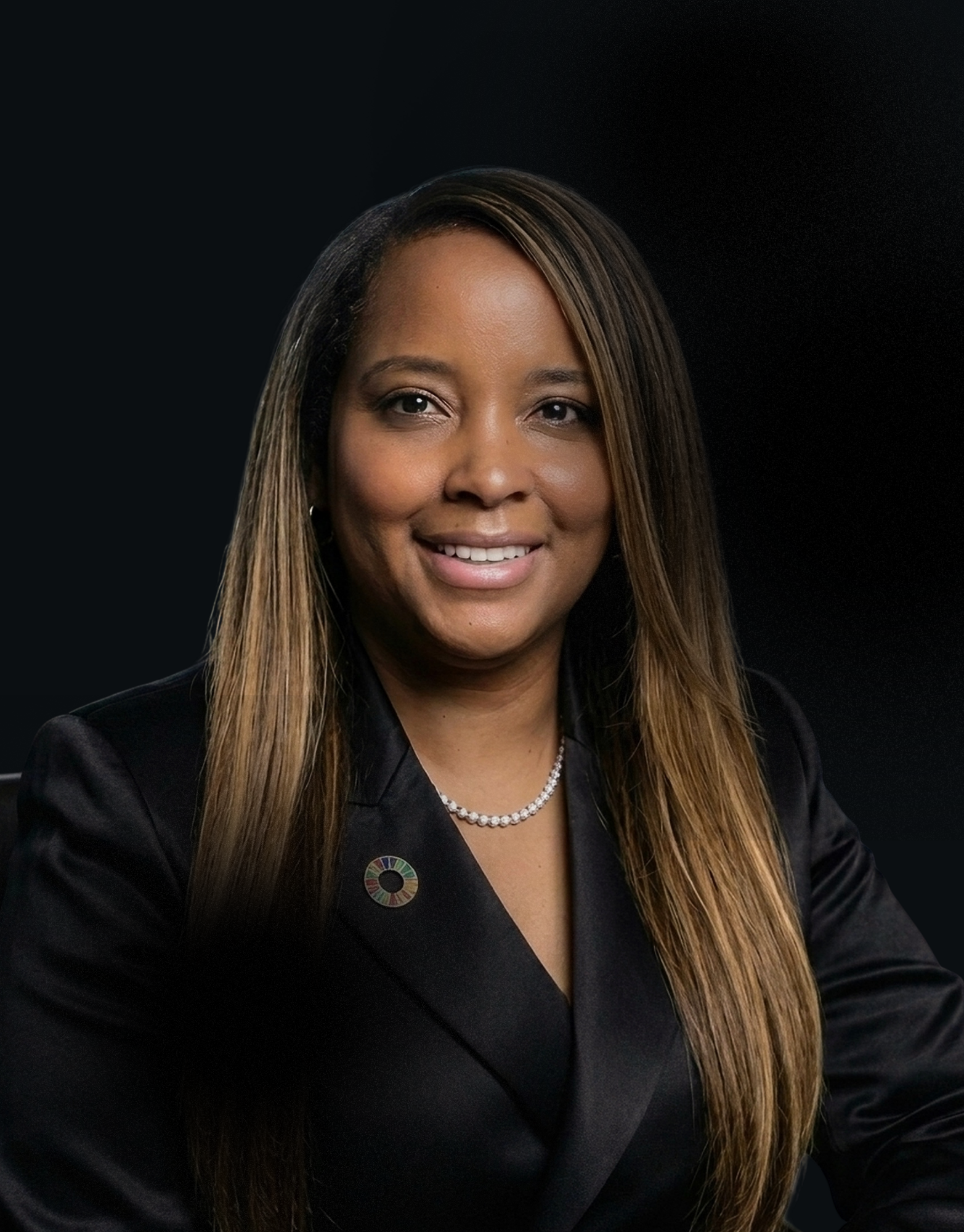
For an International Women’s Day edition themed around structural giving and lasting equity, few voices sit more credibly at the intersection of power, policy, and purpose than Her Excellency, Keisha McGuire.
Ambassador McGuire served in the Senior Cabinet of the 78th President of the United Nations General Assembly as the President’s Special Adviser on Gender Equality and Women’s Empowerment, helping to shape high-level global conversations on women’s leadership, inclusion, and systemic reform. It was a role that reflected the through-line of her career: advancing women’s equity not as rhetoric, but as architecture. She also represented Grenada as Ambassador and Permanent Representative to the United Nations, navigating multilateral diplomacy with strategic precision and building coalitions that amplified small-state influence on the world stage.
Today, as Chief Global Affairs Officer at RestoringVision, she applies that same diplomatic discipline to a different but equally urgent frontier: global eye health. Her work focuses on embedding access to vision care into national systems, particularly for women whose productivity, income, and dignity are often constrained by preventable sight loss. For Ambassador McGuire, investing in women’s access to essential care is not benevolence. It is smart economics, sound policy, and a long-term strategy for inclusive growth.
In this conversation, she reflects on what institutions must give structurally so that women can truly gain, and why restoring sight may be one of the most underestimated levers of equity in our time.
Our International Women’s Day theme this year is “Give to Gain.” In global development and public health, what does giving truly mean at an institutional level, and what do societies tangibly gain when they invest in women’s access to essential care like vision?
Giving at an institutional level goes beyond generosity, it means structural commitment. In global development and public health, institutions give by embedding women’s health needs into the systems that shape their daily lives. This includes policies that prioritize gender equity through national budgets that fund essential services, and through health systems that make care accessible, and affordable.
When institutions “give,” they create the conditions for women (and indeed all people) to claim care as a right, not a privilege. For eye care, this means integrating vision screening and eyeglasses into universal health coverage and primary health services, ensuring that every woman can access eye care when she needs it.
What societies gain from these investments is measurable and meaningful. When women have access to eye care, including something as basic as a pair of reading glasses, they improve their ability to work, to learn, to care for their families. Vision correction alone can increase productivity and expand household income. These benefits extend well beyond the individual to her community and society as a whole.
Access to something as simple as eyeglasses can transform productivity, income, and confidence. From your perspective at RestoringVision, how does restoring sight embody the principle that when we give access, we unlock economic and social gain?
Access to something as simple as a pair of eyeglasses is one of the most powerful, but overlooked economic levers in global development. Studies have shown that the annual productivity loss from vision impairment in low- and middle-income countries is at $1.1 trillion.
And we also know that solutions are readily available, especially for presbyopia — the age-related loss of near vision, which is the most common cause of avoidable vision impairment. This is where RestoringVision comes in. By providing equitable access to vision screening and near-vision eyeglasses (also known as reading glasses) to people who would otherwise not have them, we unlock opportunities for individuals to return to work, perform tasks more efficiently and safely, and live life to the fullest.
We have seen this firsthand in our programs. Our study in Peru, where we have been working with the government to deliver vision screenings and reading glasses, showed that two-thirds of eyeglasses recipients reported greater self-sufficiency, and 36% reported increased productivity, showing direct impact on lives and livelihoods.
In global affairs, resources are finite and priorities compete. Why should governments and multilateral institutions see investing in women’s eye health not as charity, but as strategy?
Sustainable eye health programs at scale require government-led integration, delivery systems, and financing; philanthropy and NGO partnerships can’t do it alone. One such proven integration model is President Bola Ahmed Tinubu’s presidential vision initiative, Jigi Bola 2.0, through which over one million people received reading glasses in just the first year of the Presidential Initiative, with two-thirds receiving their first-ever pair of eyeglasses and more than half being women.
Investing in women’s eye health delivers one of the highest returns in public health, as clear vision boosts productivity, earnings, and workforce participation. According to the International Agency for the Prevention of Blindness (IAPB) Value of Vision report, published last year, the world loses nearly $1 trillion in productivity each year due to unaddressed vision impairment. The same report found that in low- and middle-income countries, every $1 invested in eye health yields a $28 return. In this context, governments are not giving something away; they are investing in economic growth.
Further, access to eye health for women directly supports national gender equity and economic inclusion goals. When women see clearly, they can work, learn, and lead — driving progress across multiple development indicators.
Many women, particularly in low-income communities, continue to work through preventable vision challenges. What does the global system fail to recognise about the cost of overlooking women’s functional health needs?
The national systems worldwide consistently underestimate the cost of overlooking women’s functional health needs, including their vision care. Women routinely “work through” preventable vision challenges because eye care has not been normalized as a routine part of primary health and/or because of a lack of access, particularly in low-income and marginalized communities. This forces women to absorb the burden silently, adversely impacting their productivity, income, dignity, and ability to care for their families and to meaningfully contribute to society.
But the deeper cost is what happens over time: when women adapt to worsening vision instead of receiving simple, low-cost solutions like a pair of near-vision eyeglasses, it sets a powerful social norm. Entire families and communities begin to accept vision impairment as a normal part of aging rather than a correctable condition. This creates an intergenerational cycle where daughters grow up watching their mothers struggle, expecting that they too will have to “push through” diminished sight.
The global system fails to adequately recognize that women are the backbone of economic and social stability. When their sight declines, so does their ability to support their families, to earn a living, and to participate fully in their communities. By failing to integrate routine eye care into primary health systems, particularly for women at the age when presbyopia begins, the world is forfeiting enormous economic gains and reinforcing inequity.
Normalizing women’s access to routine eye care is not a luxury; it is a strategic investment. Restoring clear vision unlocks immediate productivity, income, and confidence. When we prevent needless vision loss, we protect not just a woman’s livelihood today, but the expectations and opportunities of the next generation.
“Give to Gain” also speaks to leadership. In your own career across diplomacy and now global health advocacy, how has investing in partnership, collaboration, and quiet groundwork yielded long-term influence?
When I served as Grenada’s UN Ambassador, I represented a country of under 120,000 people in an organization of 193 countries. The arithmetic of power was not in our favor. And yet, Grenada was one of the co-authors and core drivers of the UN resolution establishing the International Day of Women in Diplomacy with 191 co-sponsors. I also co-founded AfCAR (the African Group-CARICOM Collaboration Mechanism at the UNHQ in New York), which brought together 68 Member States across two of influential regional blocs in the UN, representing over a third of the entire UN membership.
That didn’t happen overnight. It happened through relationship-building that was patient, deliberate, and rooted in genuine mutual interest. When you invest in shared purpose rather than personal positioning, the coalition you build is far more impactful than anything you could have forged alone. Impact, to me, is the real definition of influence.
What I’ve found, both in diplomacy and now in global health advocacy at RestoringVision, is that the groundwork that doesn’t make headlines is often the groundwork that actually moves the needle. Whether it was co-facilitating the intergovernmentally agreed outcome at the UN ECOSOC Financing for Development Forum follow-up or now working to embed presbyopia and eye health on the agendas of governments and multilateral institutions, progress requires giving your credibility, your time, and sometimes your political capital without guarantee of immediate return. That is the investment. The gain is systemic change and on-the-ground impact that outlast any individual’s role in it.
International Women’s Day often focuses on visibility and representation. In your view, what must be given structurally such as policy reform, financing, or accountability for women to truly gain lasting equity?
Indeed, the structural elements you’ve named here are instrumental on the path to lasting equity. In the health context, policies that prioritize women’s access to care are foundational, but global health systems still tend to concentrate on maternal and child health. To truly advance equity, we must widen the lens. Women’s health needs do not end at childbirth, yet funding and policy frameworks often do. With presbyopia as the leading cause of avoidable vision impairment globally, failing to address the eye health needs of women past their reproductive years leaves millions behind.
Attaining equity requires sustainable financing mechanisms. Access to vision care, especially access to affordable, high-quality eyeglasses, must be supported through predictable, long-term channels such as government procurement, integration into insurance or national health benefits programs, and regional and international cooperation to fill gaps.
None of this is possible without accountability. Governments and global institutions must measure and report progress, ensure services reach women in low-resource communities, and track whether these investments are advancing equity.
At RestoringVision, your role involves government relations and global advocacy. What has been one moment where strategic giving, whether in trust, data, or partnership, created unexpected impact at scale?
The moment I find most instructive happened not with a grand announcement, but through data quietly doing its work. It was through sustained investment by the global eye health community in constructing and sharing the evidence base through tools like IAPB’s comprehensive Value of Vision report and Vision Atlas, through the WHO’s landmark World Report on Vision, and through tireless advocacy within the UN Friends of Vision, a group I was an inaugural member of representing Grenada.
That collective investment in rigorous data and coordinated multilateral messaging was the quiet giving. What we hoped for, but I don’t think anyone fully anticipated, was how catalytic it would become once it reached the right decision-makers at the right moment.
In 2021, the UN General Assembly passed its first-ever resolution specifically on vision, a historic milestone that reflected years of groundwork by the eye health community. And more recently, we’ve seen that momentum compound: the first-ever Global Summit for Eye Health being held in November of this year, large philanthropic investment in eye health, such as Bloomberg Philanthropies’ $75 million Vision Initiative. That level of political and philanthropic investment and commitment at scale doesn’t materialize without the political and evidentiary infrastructure that advocates had patiently built over years.
What that tells me is this: strategic giving, particularly the gift of credible data placed in the hands of policymakers and decisionmakers, creates conditions for the kind of unexpected, exponential return that no single organisation could have engineered alone. The lesson for all of us in global advocacy is that you rarely get to control when the breakthrough arrives. But you can absolutely invest in making it possible and be sure to meet the moment when it does. 2026 is truly shaping up to be a pivotal year for eye health and I commend and look forward to continuing our work with our colleagues in the sector, with governments, multilateral institutions, and all stakeholders pursuing the same goal to end avoidable vision impairment, everywhere.
On a personal level, leadership often requires giving time, energy, and intellectual labour. How do you determine what to give, what to protect, and where the return on impact is worth the sacrifice?
Honestly, this is the question that leadership rarely teaches you to answer because so much of what passes for leadership principles is actually about expansion: do more, take on more, give more. And there’s a point at which that counsel becomes genuinely dangerous, particularly for women who have often already internalized the idea that their value is proportional to the quantity versus quality of their output. From my career as an attorney in large international law firms to running a small Mission at the UN with its massive agenda to running a non-profit and now heading the Global Affairs work at RestoringVision, I have learnt that prioritization and collaboration are key and that not all giving is equal. Some giving is catalytic, some consumptive, and the art of leadership is knowing the difference.
What I’ve also learnt through experience, both victories and missteps, is that the question isn’t just “where is the impact?” but it’s “where is the irreplaceable and/or maximized contribution?” There may be things only I can bring to a particular table, by virtue of my specific experience, relationships, and perspective. That is where I try to concentrate my energy. And there are things that can and should be done by someone else, built into a system, or simply let go. Learning that distinction has been professionally and personally transformative.
I also protect the space for strategic thinking. Tactical execution can colonize every hour if you let it. But the work of diplomacy and global advocacy at the level I operate requires the ability to step back and see the whole board, to ask not just “what is the next meeting?” but “what are we actually building toward, desired outcomes and is this still the right direction?” That reflective space is non-negotiable for me, even when—especially when—the schedule makes it feel impossible.
And on sacrifice: I’ve become much more discerning about what I’m actually sacrificing for. There is giving that replenishes you because it aligns with your deepest sense of purpose. And there is giving that depletes you because it serves someone else’s agenda rather than the mission you are tasked with and/or genuinely believe in. Over the years, I’ve become better at telling the difference. The return on impact is worth it when the work connects to something larger than the moment. When I can see the thread from this conversation, this negotiation, this outreach, this advocacy effort—to an elderly person somewhere who will be able to read their medication labels clearly and take their correct prescribed dosage, or a woman who will return to work because her sight has been restored—that is when I know exactly why I’m giving what I give.
The one thought I want to end with is a simple, yet powerful 4-word mantra that has always guided me as a leader and as a woman: lift as you climb. Be a mentor, reach back and bring others along your path so successive generations would have more women leaders at the table and we see a day when the gender pay gap is a vestige of the past, when we see gender stereotypes challenged by both women and men, and gender equality is finally realized.