By Francisca Sinjae
There was something uncooperative about the energy in the room that night, it refused to sit politely in the corner like a well-trained pageant cliché. Face of Hope 2026, themed “Her Flow. Her Power.”, did not arrive to entertain expectation; it arrived to interrupt it.
From the first walk, it was clear: these women were not auditioning for approval. They were presenting evidence, of growth, of tension, of becoming. Heels struck the stage not as decoration, but as punctuation. Every step said: this is who I am, whether or not it fits your idea of who I should be.
The participants carried no single narrative, and that was precisely the point. One spoke with the sharp clarity of someone who has negotiated her way through limitation. Another moved with a softness that felt deliberate, not delicate, a quiet refusal to harden in a world that often demands it. There were voices that trembled and still told the truth, and voices that did not tremble at all. Together, they dismantled the tired assumption that confidence must look one way to count.
Backstage told its own story, less polished, more revealing. Zips were fixed by hands that were technically “competition.” Lip gloss was shared without ceremony. Encouragement passed between them in low, urgent tones. If rivalry existed, it had the decency to behave itself. What took centre stage instead was something far more interesting: solidarity without spectacle.
The audience, for their part, seemed to understand the assignment. Applause came not only for symmetry and style, but for substance, for the pause before an answer, for the courage to say something that could not be rehearsed into perfection. It was less a show, more a witnessing.
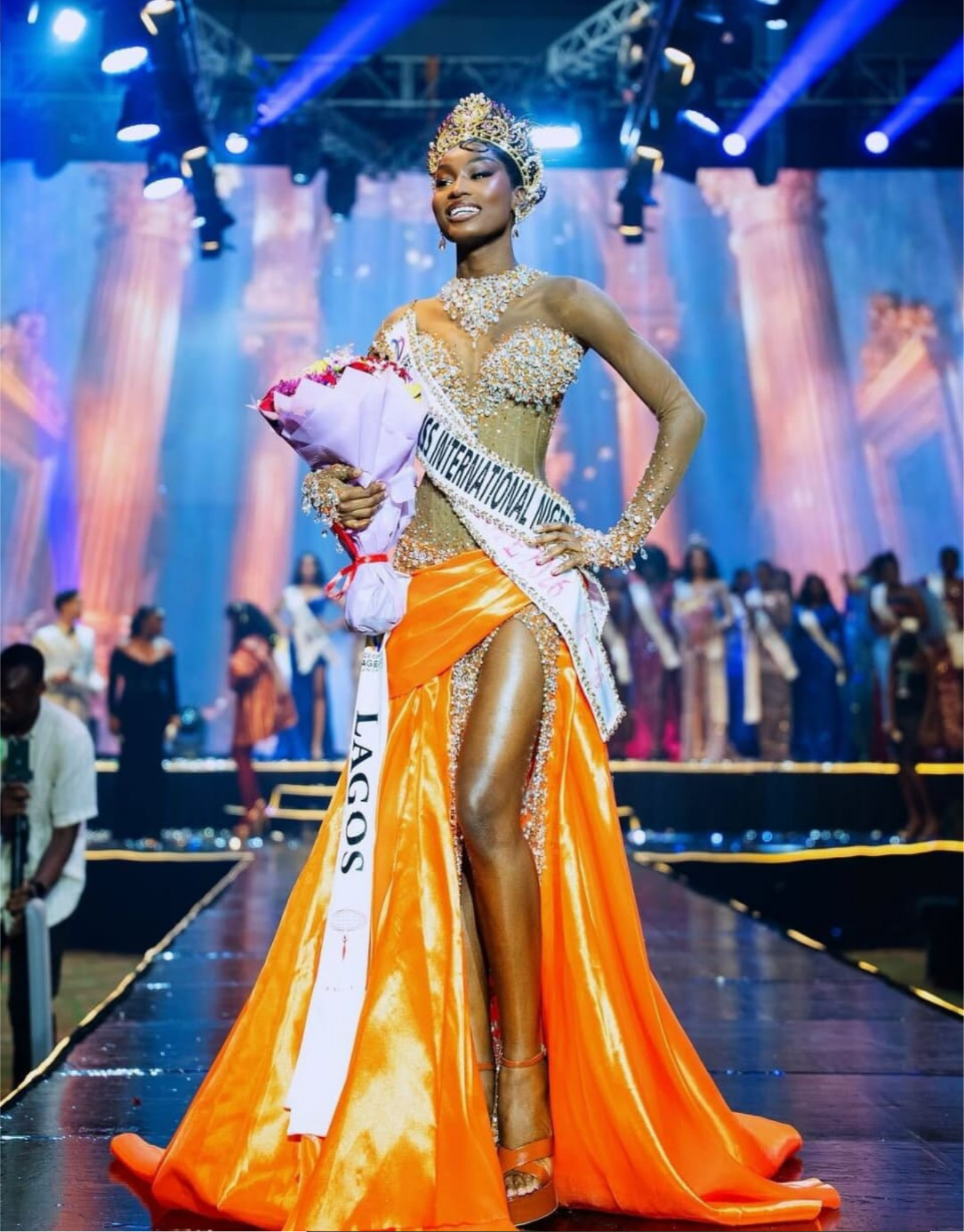
And then there was Damola, Miss Lagos, who did not so much dominate the stage as negotiate with it. Her presence was measured, but never muted. She did not rush to fill silence; she used it. Where others performed power, she seemed to edit it, paring it down to something precise and unshakeable.
When the crown found her, it felt less like a decision and more like a conclusion the room had already reached. But what lingered was not just the inevitability of her win, it was what she did with the moment.
Instead of standing apart, she folded the room back into herself.
“Tonight, this crown may rest on my head, but it was built from all of us. This was never a race against you, it was a rise with you. You are not runner-ups. You are forces, still unfolding, still becoming. This is not my win. This is ours.”
It could have been sentimental. It wasn’t. It landed because it echoed what everyone had already felt but not yet named.
“Her Flow. Her Power.” revealed itself, finally, not as branding but as method. Flow was in the way each woman navigated her own contradictions, strength and doubt, polish and rawness. Power was in the decision to stand in that complexity without apology.
No one left that stage unchanged, including the audience.
What Face of Hope 2026 managed, quietly, almost subversively, was to loosen the grip of the expected narrative. Beauty was no longer a fixed target; it moved, adapted, resisted. Power was not loud by default; sometimes it whispered and still rearranged the room.
Damola wears the crown, yes. But the real victory was less visible, more enduring: a collective shift in how presence is defined and how women choose to occupy space.
And if there was a lesson stitched into the evening, it was this, flow is not about ease. It is about continuity. Power is not about dominance. It is about authorship.
Everything else is just staging.