By Ifeoma Udu
I recently watched You, Me and Tuscany (go out and support Black love if you haven’t), and afterward I mentioned on my status that Regé-Jean Page (the Duke of Hastings) is a fine man.
Soon after, a Nigerian man entered my DMs unprovoked to inform me that Page is “gay,” and that there was no need for me to crush on him.
Firstly, I wasn’t crushing on anyone.
Second, what exactly is my business with an actor’s sexuality?
But the DM itself wasn’t the point.
What stayed with me was how quickly a neutral observation about a man’s appearance became something that needed correction.
As if women saying a man is never allowed to exist without explanation.
The Female Gaze Is Not Just Attraction
The female gaze is often reduced to “women finding men attractive,” but that misses the point.
It is not about who women like.
It is about how they are allowed to like them.
It prioritises:
• emotional presence over detachment
• expression over suppression
• intention over performative toughness
• softness without erasure
This is why certain men don’t simply stay as attractive, they become discussed.
Not because they dominate a room, but because they feel easier to read.
When Women Like Someone, the Internet Interprets It
There is a pattern that rarely changes.
When women openly find a male celebrity attractive, the conversation doesn’t stay there. It shifts into interrogation:
• Is he masculine enough?
• Why do women like him?
• Is he gay?
• Is this PR?
• What’s really going on?
Attraction is treated as incomplete data, something that must be decoded.
We’ve seen this repeatedly.
This isn’t new. Women’s admiration has long been pathologised: from Beatlemania dismissed as “hysteria” to modern fandoms labelled “obsessive.”
Unmediated female desire threatens a cultural script that expects women to be the objects of attention, not the subjects expressing it. When that script flips, the internet defaults to correction.
With One Direction, their popularity was never allowed to exist as fandom. It became commentary on softness, beauty, and what it meant for millions of women to be emotionally invested in them.
Justin Bieber experienced the same shift. Even as he matured, discussions kept circling back to his appearance, styling, and perceived masculinity.
Female attraction is rarely left untouched.
It is analysed until it becomes something else.
With groups like BTS and Stray Kids, the pattern becomes even clearer.
These men are not only visually curated, they are emotionally expressive in public. Their masculinity includes:
• styling as identity
• vulnerability without apology
• emotional articulation
• softness without fragility
Women respond to this directly.
But the backlash is predictable:
• “They look gay.”
• “They’re too feminine.”
• “That’s not masculine.”
This says less about them and more about how rigid masculine expectations remain.
Because the issue is not sexuality.
It is discomfort with masculinity that is not built for male approval and while the pushback often comes from men, it’s rarely a gender-exclusive reflex.
Women, too, participate in the sorting, sometimes policing other women’s tastes to align with respectability politics, or distancing themselves from “too much” fandom to avoid being labelled irrational.
The pattern isn’t about who speaks. It’s about who gets to define the boundaries of acceptable desire.
When Admiration Becomes Suspicion
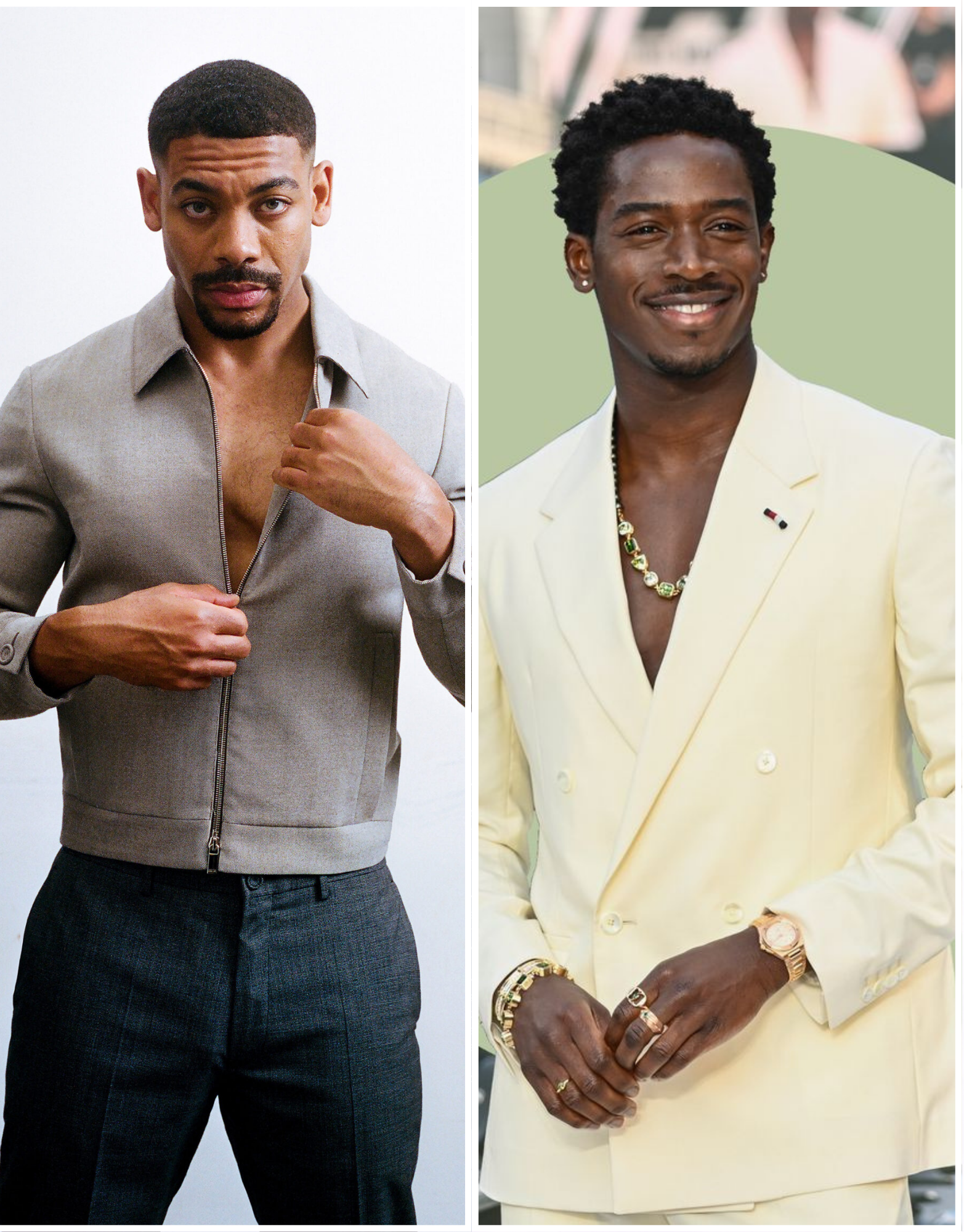
A similar pattern emerged with Aaron Pierre during the Mufasa: The Lion King wave.
As his visibility increased, especially around public moments with Teyana Taylor, admiration quickly turned into speculation:
• “This feels staged.”
• “This is PR.”
• “he is gay”
Even after the narrative shifted, the discourse didn’t settle. It expanded.
As if a widely admired man cannot exist without a hidden explanation.
As if visibility must always mean something more.
Recently, there’s been discourse around Damson Idris, the British-Nigerian actor, on Obasanjo’s internet. A number of Nigerian men have been quick to say they “don’t see the appeal”, that he looks like a regular Yoruba boy, the kind you’d find in Lekki, UNILAG, or Abuja without trying.
On the surface, it reads as humour or even harmless dismissal. What’s striking isn’t the dismissal itself, but the need to downgrade him to “regular.” In a culture that rewards exceptionalism as proof of worth, calling an attractive man “just a regular Yoruba boy” functions as a quiet correction: if he’s ordinary, then women’s attraction to him must be disproportionate, irrational, or misplaced.
But it still reveals a pattern:
Attractive men are constantly sorted:
• what kind of masculinity they represent
• what their appearance signifies
• what kind of man they “really” are
Even when no one asked.
The Real Pattern
This is not about the men.
It is about what happens when women express desire publicly.
It rarely remains:
“He is attractive.”
Instead, it becomes:
• analysis
• speculation
• correction
• classification
• explanation
Which brings me back to that DM.
A casual comment turned into something that required clarification I never asked for.
That is the pattern.
Not that women like certain men, but that women’s attraction is treated as incomplete. As something that must be translated into meaning.
Maybe the men women love are not the problem.
Maybe the discomfort begins when female desire stops asking for permission to exist out loud.
Until then, we’ll keep getting unsolicited DMs, think-pieces, and quiet corrections for saying what should be allowed to just be: he’s attractive.
And that’s enough.